


Page 52 - All About History - Issue 53-17
P. 52
Pocahonntas


                                                                                                   ground, his head was placed
                                                                                       were put on the g
                                                                                       u ppon them and a warrior raised a club to smash
                                                                                                                        g
                                                                                       his brains. Just as the club was raised a young
                                                                                       g girl leapt forward and placed her head upon his,
                                                                                       halting
                                                                                       halting the execution. That young g    f
                                                                                                               g girl was, of
                                                                                                1-year-old P
                                                                                       course, the 11-year-old Pocahontas.
                                                                                         However, the romantic and dramatic scene
                                                                                                             dramatic s
                                                                                       that Smith painted is greatly contested. Some
                                                                                       believe that what Smith experienced was not a
                                                                                       true threat to his life, but instead a ritual intended
                                                                                       to symbolise his death and rebirth as part of the
                                                                                       tribe, and he was never in any actual danger.
                                                                                       Others, however, do not believe the event occurred
                                                                                       at all. Smith neglected to mention his near death
                                                                                       experience in his earliest account of the event –
                                                                                       in 1608 he simply writes that he enjoyed a great
                                                                                       feast and a long talk with the chief. In fact, it
                                                                                       wasn’t until nine years later, when Pocahontas was
                                                                                       preparing to visit England, that he uttered a word
                                                                                       about this ‘execution’, which seems a peculiar
                                                                                       thing to leave out. It is quite possible Smith
                                                                                       invented this event to paint Pocahontas in a good
                                                                                       light before her visit.
                                                                                         Whether it happened or not, we do know that
                                                                                       Pocahontas went on to befriend the English
                                                                                       settlers in the Jamestown colony, Smith especially.
                                                                                       Curious and friendly, Pocahontas frequently
                                                                                       visited the settlement to play games with the boys,
                                                                                       as well as bringing the starving men provisions
                                                                                       from her people. She quickly became a favourite
                                                                                                    o of the colonists, and in 1609
                                                                                                     s she cemented this friendship
                                                                                                      b by saving the lives of Smith
                                                                                                      and others by warning them
                                                                                                     of an ambush. However, later
                                                                                                   that year Smith was injured in a
                                                                                                gunpowder explosion and forced to
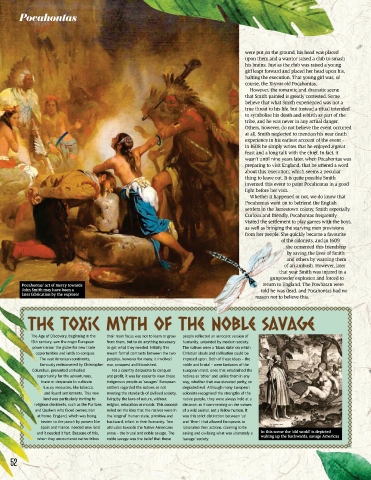
         Pocahontas’ act of mercy towards                                                    return to England. The Powhatan were
         John Smith may have been a                                                          told he was dead, and Pocahontas had no
         later fabrication by the explorer
                                                                                           reason not to believe this.


            The Age of Discovery, beginning in the   their main focus was not to learn or grow   people reflected an innocent version of
            15th century, saw the major European   from them, but to do anything necessary   humanity, untainted by modern society.
            powers scour the globe for new trade   to get what they needed. Initially this   The natives were a ‘blank slate’ on which
              opportunities and lands to conquer.   meant formal contracts between the two   Christian ideals and civilisation could be
               The vast American continents,   peoples, however for many, it involved   imposed upon. Both of these ideas – the
               famously rediscovered by Christopher  war, conquest and bloodshed.   noble and brutal – were fantasies of the
            Columbus, presented unrivalled   For a country desperate to conquer   European mind, ones that established the
              opportunity for the adventurous,   and profit, it was far easier to view these   natives as ‘other’ and unlike them in any
               brave or desperate to cultivate   indigenous people as ‘savages’. European   way, whether that was elevated purity, or
                luxury resources, like tobacco,   settlers regarded the natives as not   degraded evil. Although many European
                 and found settlements. This new   meeting the standards of civilised society,   colonists recognised the strengths of the
                land was particularly inviting to   living by the laws of nature, without   native people, they were always held at a
             religious dissidents, such as the Puritans   religion, education or morals. This concept   distance, as if commenting on the virtues
             and Quakers who faced persecution   relied on the idea that the natives were in   of a wild animal, not a fellow human. It
              at home. England, which was being   the ‘original’ human state, primitive and   was this strict distinction between ‘us’
               beaten to the punch by powers like   backward, infant in their humanity. Two   and ‘them’ that allowed Europeans to
               Spain and France, needed new land   attitudes towards the Native Americans   rationalise their actions, claiming to be
              and it needed it fast. Because of this,   arose – the brutal and noble savage. The   saving and civilising what was ultimately a   In this scene the ‘old world’ is depicted
                                                                                             waking up the backwards, savage Americas
              when they encountered native tribes   noble savage was the belief that these   ‘savage’ society.


      2 52

