


Page 55 - All About History - Issue 53-17
P. 55
h
                                                                                                        Poocahontas
                                                                                                                           s


          Pocahontas lived peacefully with Rolfe on his   Powhatan natives, Pocahontas travelled to England   even a daughter of a chief, would be treated
        plantation for two years, however, the tale of   in 1616. The party toured the country attending   with an unbiased degree of respect. For many
        the converted ‘savage’ travelled quickly through   various social gatherings, and in 1617 she met King   of the locals she and the other Powhatans were
        to the Virginia Company, the trading business   James at the Palace of Whitehall. As the daughter   regarded as curiosities, to be gawked and stared
        who financed the colonies on the east coast.   of the chief, Pocahontas was presented as a   at. Pocahontas wasn’t presented as how cultured
        The company saw her marriage, conversion and   princess and although this did not fit the Powhatan   a ‘savage’ could be, but instead, how much the
        subsequent peace as a great marketing opportunity   culture, it afforded her a high degree of respect in   English nation could do to ‘better’ them.
        to promote investment in Jamestown. Leaping on   the country. Pocahontas seemed to leave a good   It was during her time in England that
        the PR opportunity, the Virginia Company paid for   impression on the people, most likely coached by   Pocahontas was reunited with an old friend. John
        Pocahontas and her family to travel to England.   the Virginia Company, and she presented herself a   Smith, who she had been told was dead, met the
        This was no mere holiday – this trip was made   polite, cultured lady.         couple at a social gathering and, according to
        with the intention of displaying what England   However, this was not the case for everyone. The   Smith, Pocahontas was so overcome with emotion
        could do for the ‘savages’ and to promote how well   ‘new world’ was still frightening and mysterious   that she was unable to speak or look at him. After
        Jamestown was doing, and Pocahontas was chosen   to many Europeans, and the bias of the ‘brutal   finding her voice she was quick to remind him
        to be the poster child.                savage’ was firmly ingrained in many. It is almost   of the kind things she had done for him, and
          Accompanied by around a dozen other   impossible to imagine that a Native American,   the terrible way his people had treated her own.
                                                                                       She discomforted him further by calling him
                                                                                       ‘father’ as he had done to her own father. When
                                                                                       he did not allow this, she became passionate and
                                                                                       angry and said: “Were you not afraid to come
                                                                                       into my father’s country and caused fear in him
                                                                                       and all his people (but me) and fear you here I
                                                                                       should call you ‘father’?” Finally she informed
                                                                                       Smith that the English had said he was dead, but
                                                                                       Wahunsenacawh had suspected otherwise as “your
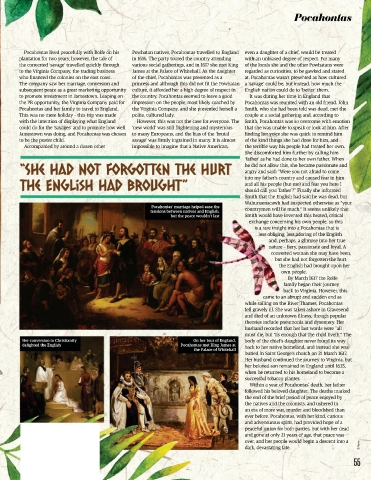
                                                      Pocahontas’ marriage helped ease the
                                                      tensions between natives and English,   countrymen will lie much.” It seems unlikely that
                                                             but the peace wouldn’t last  Smith would have invented this heated, critical
                                                                                        exchange concerning his own people, so this
                                                                                          is a rare insight into a Pocahontas that is
                                                                                            less obliging, less adoring of the English
                                                                                               and, perhaps, a glimpse into her true
                                                                                               nature – fiery, passionate and loyal. A
                                                                                                converted woman she may have been,
                                                                                                  but she had not forgotten the hurt
                                                                                                   the English had brought upon her
                                                                                                    own people.
                                                                                                      By March 1617 the Rolfe
                                                                                                     family began their journey
                                                                                                     back to Virginia. However, this
                                                                                             came to an abrupt and sudden end as
                                                                                       while sailing on the River Thames, Pocahontas
                                                                                       fell gravely ill. She was taken ashore in Gravesend
                                                                                       and died of an unknown illness, though popular
                                                                                       theories include pneumonia and dysentery. Her
                                                                                       husband recorded that her last words were “all
                                                                                       must die, but ‘tis enough that the child liveth.” The
         Her conversion to Christianity                              On her tour of England,   body of the chief’s daughter never found its way
         delighted the English                                   Pocahontas met King James at
                                                                     the Palace of Whitehall  back to her native homeland, and instead she was
                                                                                       buried in Saint George’s church on 21 March 1617.
                                                                                       Her husband continued the journey to Virginia, but
                                                                                       her beloved son remained in England until 1635,
                                                                                       when he returned to his homeland to become a
                                                                                       successful tobacco planter.
                                                                                         Within a year of Pocahontas’ death, her father
                                                                                       followed his beloved daughter. The deaths marked
                                                                                       the end of the brief period of peace enjoyed by
                                                                                       the natives and the colonists, and ushered in
                                                                                       an era of more war, murder and bloodshed than
                                                                                       ever before. Pocahontas, with her kind, curious
                                                                                       and adventurous spirit, had provided hope of a
                                                                                       peaceful union for both parties, but with her dead
                                                                                       and gone at only 21 years of age, that peace was
                                                                                       over, and her people would begin a descent into a
                                                                                       dark, devastating fate.                 © Alamy
                                                                                                                             55

