


Page 90 - All About History - Issue 53-17
P. 90
REVIEWS


                         All About History on the books, TV shows and

                                films causing a stir in the history world

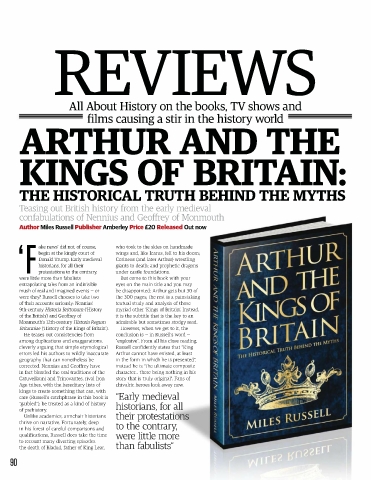
        ARTHUR AND THE


        KINGS OF BRITAIN:


        THE HISTORICAL TRUTH BEHIND THE MYTHS


        Teasing out British history from the early medieval
        confabulations of Nennius and Geoffrey of Monmouth
        Author Miles Russell Publisher Amberley Price £20 Released Out now


               ake news’ did not, of course,   who took to the skies on handmade
               begin at the kingly court of   wings and, like Icarus, fell to his doom;
               Donald Trump. Early medieval   Corineus (and later Arthur) wrestling
               historians, for all their   giants to death; and prophetic dragons
       ‘F protestations to the contrary,   under castle foundations.
        were little more than fabulists    But come to this book with your
        extrapolating tales from an indivisible   eyes on the main title and you may
        mush of real and imagined events — or   be disappointed: Arthur gets but 30 of
        were they? Russell chooses to take two   the 300 pages; the rest is a painstaking
        of their accounts seriously: Nennius’   textual study and analysis of those
        9th-century Historia Brittonum (‘History   myriad other ‘Kings of Britain’. Instead,
        of the British’) and Geoffrey of   it is the subtitle that is the key to an
        Monmouth’s 12th-century Historia Regum   admirable but sometimes stodgy read.
        Britanniae (‘History of the Kings of Britain’).  However, when we get to it, the
          He teases out consistencies from   conclusion is — in Russell’s word —
        among duplications and exaggerations,   “explosive”. From all his close reading,
        cleverly arguing that simple etymological   Russell confidently states that “King
        errors led his authors to wildly inaccurate   Arthur cannot have existed, at least
        geography that can nonetheless be   in the form in which he is presented”,
        corrected. Nennius and Geoffrey have   instead he is “the ultimate composite
        in fact blended the oral traditions of the   character… there being nothing in his
        Catuvellauni and Trinovantes, rival Iron   story that is truly original”. Fans of
        Age tribes, with the hereditary lists of   chivalric heroes look away now.
        kings to create something that can, with
        care (Russell’s catchphrase in this book is  “Early medieval
        “garbled”), be treated as a kind of history   historians, for all
        of prehistory.
          Unlike academics, armchair historians   their protestations
        thrive on narrative. Fortunately, deep   to the contrary,
        in his forest of careful comparisons and
        qualifications, Russell does take the time   were little more
        to recount many diverting episodes —
        the death of Bladud, father of King Lear,   than fabulists”
     90

