


Page 245 - (DK) The Dog Encyclopedia
P. 245
GUNDOGS


           Irish Setter                                                                          BIG RED


                                                                                                 In North America the Irish Setter’s free spirit
                 HEIGHT       WEIGHT       LIFE SPAN                                             was made famous by the 1962 Disney film Big
                 25–27in      60–71lb      12–13 years                                           Red. Set in Canada, the film tells of a champion
                 (64–69cm)    (27–32kg)                                                          show dog, Big Red, who makes friends with
                                                                                                 an orphan boy called René. Big Red becomes
                                                                                                 more interested in hunting with René than
          This exuberant, enthusiastic dog is both glamorous                                     being a good show dog, and as a result his
          and affectionate but needs a patient and active owner                                  owner gets rid of him. Big Red escapes across
                                                                                                 country and is reunited with René when the
                                                                                                 two friends heroically save the dog’s owner
          Hunting dogs called “setters”—dogs that   color became the standard for the Irish
                                                                                                 from a cougar.
          would crouch, or “set,” near game birds to   Setter. Even now, however, some dogs are
          show the birds’ location—were first        born with small, white markings.
          mentioned in English texts of the late 16th    By the 1850s the red Irish Setter had
          to early 17th century and were recognized as   spread through Ireland and the UK, and
          a distinct type in the 18th century. The Irish   began to be seen in the show ring. A male
          Setter was created in the 18th century,   named Palmerston, born in 1862, was the
          possibly from crosses of breeds including the  first champion show and stud dog and is the
          English Setter (see p.241), the Gordon Setter   ancestor of most modern Irish setters.
          (see p.240), and the Irish Water Spaniel (see   Today the breed is mainly a show dog or a
          p.228), as well as other spaniels and     companion, but some breeders still produce
          pointers. Bred for hunting birds in upland   dogs for working ability as well as looks.
          areas, it was valued for its speed, efficiency,   The Irish Setter makes a striking,
                    and keen nose.                  affectionate pet with a love of children and
                             The first dogs were red   other dogs and a great sense of fun. Slow
                         and white like today’s Irish   to mature, it requires firm training from
                         Red and White Setter (see   an early age. The breed needs a home
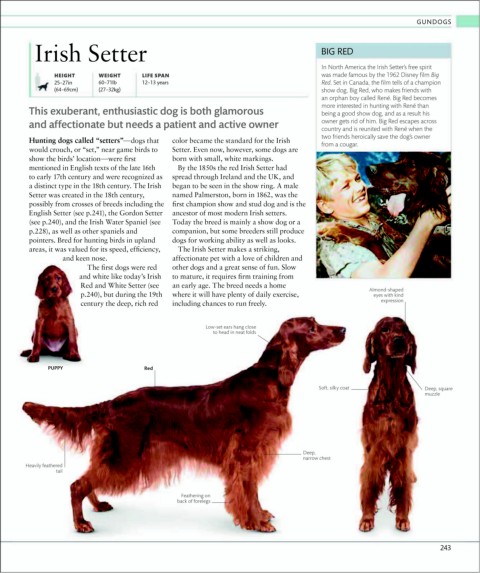
                                                                                                               Almond-shaped
                         p.240), but during the 19th   where it will have plenty of daily exercise,             eyes with kind
                                                                                                                  expression
                         century the deep, rich red   including chances to run freely.

                                                              Low-set ears hang close
                                                                to head in neat folds


               PUPPY                        Red


                                                                                                Soft, silky coat                Deep, square
                                                                                                                                muzzle


                                                                                           Deep,
                                                                                           narrow chest
         Heavily feathered
                  tail


                                                       Feathering on
                                                      back of forelegs


                                                                                                                                    243

