


Page 271 - (DK) The Dog Encyclopedia
P. 271
COMPANION DOGS


           Pug                                                                                   CHANGING FACES


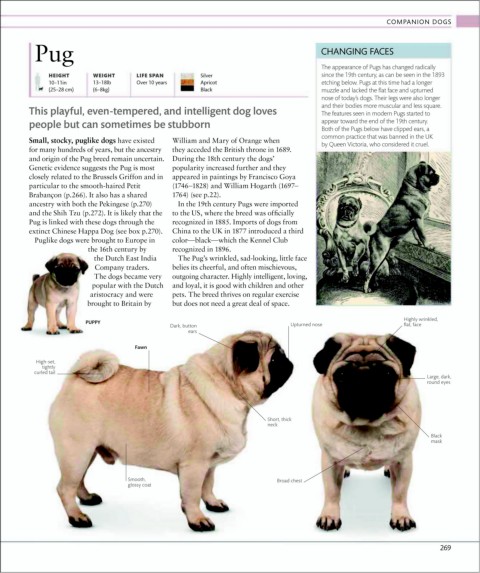
                                                                                                 The appearance of Pugs has changed radically
               HEIGHT        WEIGHT       LIFE SPAN          Silver                              since the 19th century, as can be seen in the 1893
               10–11in       13–18lb      Over 10 years      Apricot                             etching below. Pugs at this time had a longer
               (25–28 cm)    (6–8kg)                         Black                               muzzle and lacked the flat face and upturned
                                                                                                 nose of today’s dogs. Their legs were also longer
                                                                                                 and their bodies more muscular and less square.
          This playful, even-tempered, and intelligent dog loves                                 The features seen in modern Pugs started to
          people but can sometimes be stubborn                                                   appear toward the end of the 19th century.
                                                                                                 Both of the Pugs below have clipped ears, a
                                                                                                 common practice that was banned in the UK
          Small, stocky, puglike dogs have existed   William and Mary of Orange when
                                                                                                 by Queen Victoria, who considered it cruel.
          for many hundreds of years, but the ancestry   they acceded the British throne in 1689.
          and origin of the Pug breed remain uncertain.  During the 18th century the dogs’
          Genetic evidence suggests the Pug is most   popularity increased further and they
          closely related to the Brussels Griffon and in  appeared in paintings by Francisco Goya
          particular to the smooth-haired Petit     (1746–1828) and William Hogarth (1697–
          Brabançon (p.266). It also has a shared   1764) (see p.22).
          ancestry with both the Pekingese (p.270)    In the 19th century Pugs were imported
          and the Shih Tzu (p.272). It is likely that the   to the US, where the breed was officially
          Pug is linked with these dogs through the   recognized in 1885. Imports of dogs from
          extinct Chinese Happa Dog (see box p.270).   China to the UK in 1877 introduced a third
           Puglike dogs were brought to Europe in   color—black—which the Kennel Club
                           the 16th century by      recognized in 1896.
                             the Dutch East India     The Pug’s wrinkled, sad-looking, little face
                             Company traders.       belies its cheerful, and often mischievous,
                             The dogs became very   outgoing character. Highly intelligent, loving,
                            popular with the Dutch  and loyal, it is good with children and other
                            aristocracy and were    pets. The breed thrives on regular exercise
                           brought to Britain by    but does not need a great deal of space.

                                                                                                                         Highly wrinkled,
                          PUPPY
                                                    Dark, button                        Upturned nose                    flat, face
                                                         ears
                                         Fawn

            High-set,
             tightly
           curled tail
                                                                                                                                Large, dark,
                                                                                                                                round eyes


                                                                                 Short, thick
                                                                                 neck
                                                                                                                                 Black
                                                                                                                                 mask


                                       Smooth,                                     Broad chest
                                       glossy coat


                                                                                                                                    269

