


Page 274 - (DK) The Dog Encyclopedia
P. 274
CATALOG OF BREEDS  |  COMPANION DOGS


           Shih Tzu


                HEIGHT       WEIGHT       LIFE SPAN          Variety of colors
                Up to 11in   11–18lb      Over 10 years
                (27cm)       (5–8kg)


          This intelligent, bouncy, and outgoing dog loves being part
          of the family, making it a popular pet around the world

                                                                                                               Black and
          This sturdy breed is descended from the   dogs survived in the UK and Norway, and the                   white
          small, long-haired “lion dogs” that were   English dogs formed the basis of today’s Shih
          originally bred in Tibet. Tibetan lamas   Tzu. The breed was officially recognized in
          (spiritual leaders) sent some of these valuable   the UK in 1934. English Shih Tzus were
          dogs as tributes to the Chinese emperors,    exported to Europe and Australia and, after
          and these were then crossed with small    World War II, reached the US, too. In their
          dogs imported from the West in previous   native land, however, numbers had been in
          centuries. Like the Pekingese (see p.270), the   decline, and by the time of the Communist
          Shih Tzu was revered as a holy dog because it   revolution in 1949, Shih Tzus had become
          resembled the Chinese notion of a lion, which   almost extinct in China. Today the Shih Tzu
          was a holy Buddhist symbol. The breed name   is one of the world’s most popular toy breeds.
          means “little lion” in Chinese.           Despite its dignified carriage, the Shih Tzu
             The Shih Tzu was a favorite with                makes an affectionate and friendly
          royalty. During the late 19th century                pet, although it can be strong-
          Dowager Empress Cixi kept                             willed. The long coat requires
          breeding kennels for Shih Tzus                         daily grooming but sheds little
          (as well as Pugs (see p.268) and                       or no hair, making this breed
          Pekingese (see p.270), but after                       suitable for allergy sufferers.
          her death in 1908 the dogs
          were dispersed.
             After China became a
                                                                Gold with
          republic in 1912, Shih Tzus                           black mask
          were exported overseas.
          Small groups of imported                              PUPPY


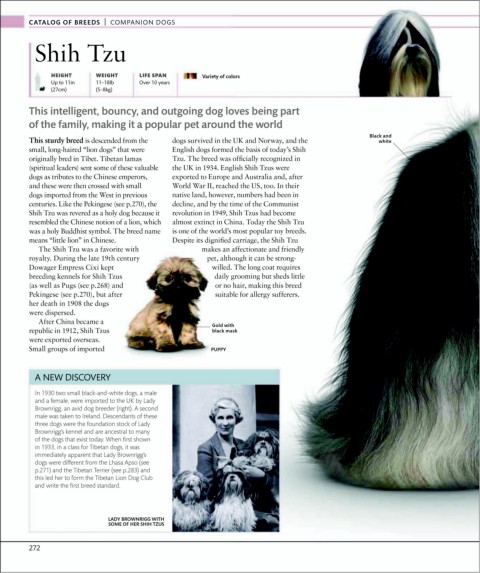
           A NEW DISCOVERY

           In 1930 two small black-and-white dogs, a male
           and a female, were imported to the UK by Lady
           Brownrigg, an avid dog breeder (right). A second
           male was taken to Ireland. Descendants of these
           three dogs were the foundation stock of Lady
           Brownrigg’s kennel and are ancestral to many
           of the dogs that exist today. When first shown
           in 1933, in a class for Tibetan dogs, it was
           immediately apparent that Lady Brownrigg’s
           dogs were different from the Lhasa Apso (see
           p.271) and the Tibetan Terrier (see p.283) and
           this led her to form the Tibetan Lion Dog Club
           and write the first breed standard.


                                 LADY BROWNRIGG WITH
                                 SOME OF HER SHIH TZUS


          272

