


Page 326 - (DK) The Dog Encyclopedia
P. 326
CARE AND TRAINING  |  BASIC TRAINING


          Basic training


          Training should be an enjoyable experience for both you and your dog. The following
          pages introduce some basic commands and will help to get you started, but if you are
          unsure, always seek the help of a professional dog trainer sooner rather than later.


          WHEN TO TRAIN                             making the wrong decision. Start training   soon disappear and be replaced by
          There are many things to consider while   him in a quiet, distraction-free environment   behavior that is rewarded. For your dog
          training, but the most important is to    such as your living room, especially when   to understand how you want him to behave,
          choose the right time. Aim to train for    attempting to teach new or difficult       give him the reward as soon as he has
          a few minutes several times a day, since this    commands. When you do move training   behaved in the way you would like. Rewards
          will produce much better results than a   outside, start somewhere quiet and enclosed,  can include food treats, games with toys,
          longer training session once a day. Choose   far from other dogs and people. You can   simple praise and affection, or even playing
          times when you are not stressed or in a rush,  then build up to training in high-distraction   with other dogs. Remember that not all
          otherwise your dog will sense your tension   environments such as a local park, but do not  dogs find the same rewards appealing.
          and be far more likely to get things wrong    attempt this until your puppy has had plenty   Spend some time discovering what really
          in his attempts to please you.            of practice already and has been inoculated.   motivates your dog and use that as a reward.
           Equally important is to consider your                                                 One of the easiest reward-based ways
          puppy’s mood. Trying to train an overexcited   REWARD-BASED TRAINING                 of training is to use a food treat to lure your
          puppy that hasn’t had much exercise will be   Training your dog involves creating a   dog into the position you want him to be
          difficult. And a puppy that has just eaten a   situation where he is rewarded for certain   in. Food treats should be small, soft, and
          large meal will feel sleepy and will not be   behaviors instead of others. Any behavior   smelly. They work best when they can be
          particularly motivated by food treats.    that is consistently rewarded will be      given quickly during training sessions and
          Maximize your training success by limiting   repeated more often. This also means that   do not take your dog several minutes to
          his choices and thus preventing him from   bad behavior, which is not rewarded, will   eat. More complicated behaviors can be


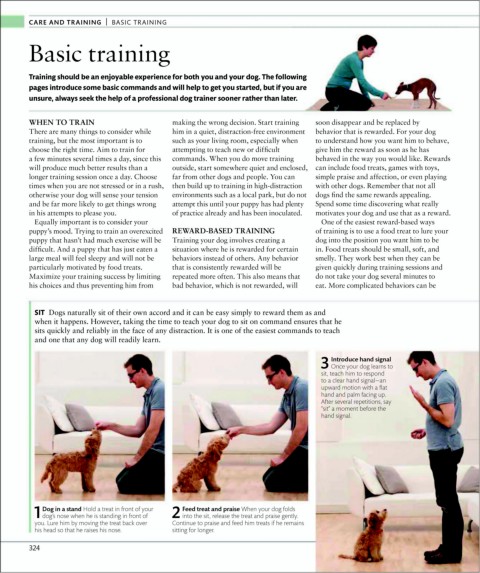
           SIT  Dogs naturally sit of their own accord and it can be easy simply to reward them as and
           when it happens. However, taking the time to teach your dog to sit on command ensures that he
           sits quickly and reliably in the face of any distraction. It is one of the easiest commands to teach
           and one that any dog will readily learn.

                                                                                                    Introduce hand signal
                                                                                                3   Once your dog learns to
                                                                                                 sit, teach him to respond
                                                                                                 to a clear hand signal—an
                                                                                                 upward motion with a flat
                                                                                                 hand and palm facing up.
                                                                                                 After several repetitions, say
                                                                                                 “sit” a moment before the
                                                                                                 hand signal.


             Dog in a stand Hold a treat in front of your   Feed treat and praise When your dog folds
           1  dog’s nose when he is standing in front of   2   into the sit, release the treat and praise gently.
           you. Lure him by moving the treat back over    Continue to praise and feed him treats if he remains
           his head so that he raises his nose.     sitting for longer.


          324

