


Page 330 - (DK) The Dog Encyclopedia
P. 330
CARE AND TRAINING  |  BASIC TRAINING


          TRAINING CLASSES                          uncomfortable. Nervous dogs and those that  organization such as the American Kennel
          No matter how much experience you have    are aggressive toward people or other dogs   Club. Before you choose a class, take the
          training dogs, classes are advisable for any   are not suitable for group classes. These   time to visit and watch a training session
          new dog—whether it be a puppy or an older,  types of behavioral problems are often   take place. Even if you have no experience
          rescued dog. The benefits dogs receive from   aggravated in a class situation and     of training classes, you will quickly get
          taking part in a group class are significant   can become more pronounced. Quite      a feel for a good class. Aim for classes
          and it is also a useful way to hone your   often these dogs are better starting off    with relaxed dogs and happy owners.
          skills. In training classes you will meet other  in a one-to-one training session, with   Avoid hectic and noisy environments and
          like-minded people and learn about the    someone who is qualified in dealing with    classes. A knowledgeable and experienced
          facilities your local area has to offer dog   behavioral problems, before progressing into   trainer will take charge in a friendly and
          owners. All dogs are different and will   a group class. If you have any concerns, ask   effective manner.
          benefit from slightly varied approaches in   before enrolling your dog. All training
          their training. Furthermore, having an    classes teach the basic skill of getting your
          experienced trainer on hand will prevent   dog to walk to heel. If you can keep your   WHAT TO LOOK FOR
          you from making mistakes. It is also much   dog by your side in a controlled environment   IN A CLASS
          easier to keep motivated when training as   you will soon be able to walk him in public
          part of a group.                          spaces with confidence.                       ■ Small classes with only a few dogs.
           Training classes should be well organized                                             ■ High trainer-to-dog ratio.
          and enjoyable for all the owners and dogs   WHERE TO TRAIN                             ■  Positive training methods utilizing
          present. A happy, confident dog will move    There are likely to be several classes running   praise, food, and toys.
                                                                                                 ■ No choke chains.
          in a relaxed manner during these classes.    in your area. Try to get recommendations
                                                                                                 ■ No aggressive training.
          Any sign of tension, evident in a stiffening   from other dog owners or your vet. Choose
                                                                                                 ■ A relaxed environment.
          of the body, is a warning that he feels   a trainer who is recognized by an official


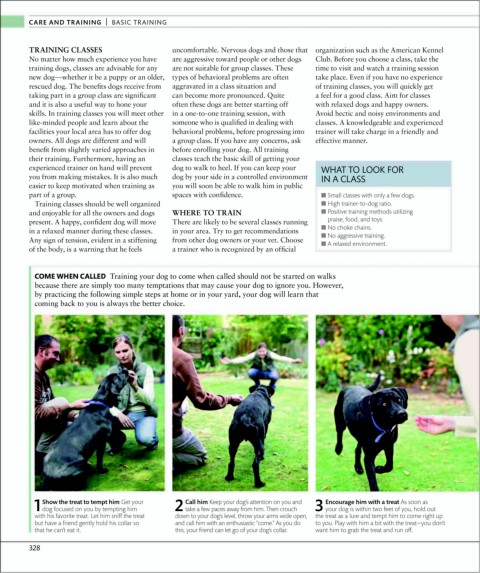
           COME WHEN CALLED  Training your dog to come when called should not be started on walks
           because there are simply too many temptations that may cause your dog to ignore you. However,
           by practicing the following simple steps at home or in your yard, your dog will learn that
           coming back to you is always the better choice.


             Show the treat to tempt him Get your       Call him Keep your dog’s attention on you and   Encourage him with a treat As soon as
           1  dog focused on you by tempting him     2   take a few paces away from him. Then crouch  3   your dog is within two feet of you, hold out
           with his favorite treat. Let him sniff the treat    down to your dog’s level, throw your arms wide open,   the treat as a lure and tempt him to come right up
           but have a friend gently hold his collar so    and call him with an enthusiastic “come.” As you do   to you. Play with him a bit with the treat—you don’t
           that he can’t eat it.                     this, your friend can let go of your dog’s collar.  want him to grab the treat and run off.


          32 8
          328

