


Page 78 - (DK) The Dog Encyclopedia
P. 78
CATALOG OF BREEDS  |  WORKING DOGS


           Saint Bernard


                  HEIGHT       WEIGHT       LIFE SPAN          Brindle
                  28–30in      130–180lb    8–10 years
                  (70–75cm)    (59–81kg)


          This kindly giant has a delightful temperament but its
          unrivaled size prohibits it from being a pet for many
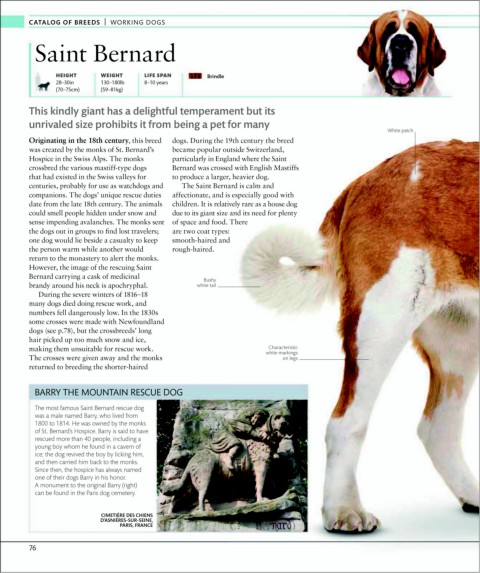
                                                                                                                    White patch
          Originating in the 18th century, this breed   dogs. During the 19th century the breed
          was created by the monks of St. Bernard’s   became popular outside Switzerland,
          Hospice in the Swiss Alps. The monks      particularly in England where the Saint
          crossbred the various mastiff-type dogs    Bernard was crossed with English Mastiffs
          that had existed in the Swiss valleys for   to produce a larger, heavier dog.
          centuries, probably for use as watchdogs and     The Saint Bernard is calm and
          companions. The dogs’ unique rescue duties   affectionate, and is especially good with
          date from the late 18th century. The animals   children. It is relatively rare as a house dog
          could smell people hidden under snow and   due to its giant size and its need for plenty
          sense impending avalanches. The monks sent  of space and food. There
          the dogs out in groups to find lost travelers;   are two coat types:
          one dog would lie beside a casualty to keep   smooth-haired and
          the person warm while another would       rough-haired.
          return to the monastery to alert the monks.
          However, the image of the rescuing Saint
          Bernard carrying a cask of medicinal
                                                              Bushy
          brandy around his neck is apochryphal.            white tail
             During the severe winters of 1816–18
          many dogs died doing rescue work, and
          numbers fell dangerously low. In the 1830s
          some crosses were made with Newfoundland
          dogs (see p.78), but the crossbreeds’ long
          hair picked up too much snow and ice,
          making them unsuitable for rescue work.                                Characteristic
                                                                                white markings
          The crosses were given away and the monks                                  on legs
          returned to breeding the shorter-haired


           BARRY THE MOUNTAIN RESCUE DOG


           The most famous Saint Bernard rescue dog
           was a male named Barry, who lived from
           1800 to 1814. He was owned by the monks
           of St. Bernard’s Hospice. Barry is said to have
           rescued more than 40 people, including a
           young boy whom he found in a cavern of
           ice; the dog revived the boy by licking him,
           and then carried him back to the monks.
           Since then, the hospice has always named
           one of their dogs Barry in his honor.
           A monument to the original Barry (right)
           can be found in the Paris dog cemetery.


                               CIMETIÈRE DES CHIENS
                               D’ASNIÉRES-SUR-SEINE,
                                     PARIS, FRANCE


          76

