


Page 130 - (DK Eyewitness) Travel Guide - South Africa
P. 130
128 C APE T OWN
By 1807, new premises from
which to administer the Cape
Colony were needed, and
the Slave Lodge suited most
requirements. Many slave
inhabitants of the lodge were
sold, while others were moved
to the west wing of the
building. The vacated area was
turned into offices. In 1811, the
west wing was also converted.
The people responsible for
the conversion were the
builder Herman Schutte, the
sculptor Anton Anreith and the
architect Louis Michel Thibault.
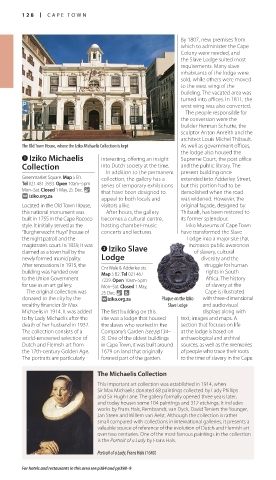
The Old Town House, where the Iziko Michaelis Collection is kept As well as govern ment offices,
the lodge also housed the
1 Iziko Michaelis interesting, offering an insight Supreme Court, the post office
Collection into Dutch society at the time. and the public library. The
In addition to the permanent present building once
Greenmarket Square. Map 5 B1. collection, the gallery has a extended into Adderley Street,
Tel 021 481 3933. Open 10am–5pm series of temporary exhibitions but this portion had to be
Mon–Sat. Closed 1 May, 25 Dec. & that have been designed to demolished when the road
∑ iziko.org.za
appeal to both locals and was widened. However, the
Located in the Old Town House, visitors alike. original façade, designed by
this national monu ment was After hours, the gallery Thibault, has been restored to
built in 1755 in the Cape Rococo becomes a cultural centre, its former splendour.
style. It initially served as the hosting chamber-music Iziko Museums of Cape Town
“Burgherwacht Huys” (house of concerts and lectures. have transformed the Slave
the night patrol) and the Lodge into a major site that
magistrate’s court. In 1839, it was 2 Iziko Slave increases public awareness
claimed as a town hall by the of slavery, cultural
newly formed municipality. Lodge diversity and the
After renovations in 1915, the Cnr Wale & Adderley sts. struggle for human
building was handed over Map 5 B2. Tel 021 467 rights in South
to the Union Government 7229. Open 10am–5pm Africa. The history
for use as an art gallery. Mon–Sat. Closed 1 May, of slavery at the
The original collection was 25 Dec. & 7 Cape is illustrated
donated to the city by the ∑iziko.org.za Plaque on the Iziko with three-dimensional
wealthy financier Sir Max Slave Lodge and audiovisual
Michaelis in 1914. It was added The first building on this displays along with
to by Lady Michaelis after the site was a lodge that housed text, images and maps. A
death of her husband in 1932. the slaves who worked in the section that focuses on life
The collection consists of a Company’s Garden (see pp134– at the lodge is based on
world-renowned selection of 5). One of the oldest buildings archaeological and archival
Dutch and Flemish art from in Cape Town, it was built around sources, as well as the memories
the 17th-century Golden Age. 1679 on land that originally of people who trace their roots
The portraits are particularly formed part of the garden. to the time of slavery in the Cape.
The Michaelis Collection
This important art collection was established in 1914, when
Sir Max Michaelis donated 68 paintings collected by Lady Phillips
and Sir Hugh Lane. The gallery formally opened three years later,
and today houses some 104 paintings and 312 etchings. It includes
works by Frans Hals, Rembrandt, van Dyck, David Teniers the Younger,
Jan Steen and Willem van Aelst. Although the collection is rather
small compared with collections in international galleries, it presents a
valuable source of reference of the evolution of Dutch and Flemish art
over two centuries. One of the most famous paintings in the collection
is the Portrait of a Lady by Frans Hals.
Portrait of a Lady, Frans Hals (1640)
For hotels and restaurants in this area see p384 and pp398–9
128-129_EW_South_Africa.indd 128 25/05/17 2:45 pm

