


Page 138 - (DK Eyewitness) Travel Guide - South Africa
P. 138
136 C APE T OWN
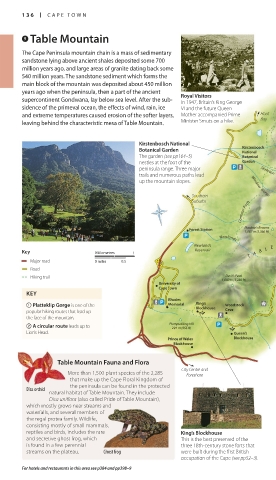
9 Table Mountain
The Cape Peninsula mountain chain is a mass of sedimentary
sandstone lying above ancient shales deposited some 700
million years ago, and large areas of granite dating back some
540 million years. The sand stone sediment which forms the
main block of the mountain was deposited about 450 million
years ago when the peninsula, then a part of the ancient Royal Visitors
supercontinent Gondwana, lay below sea level. After the sub In 1947, Britain’s King George
sid ence of the primeval ocean, the effects of wind, rain, ice VI and the future Queen
and extreme temperatures caused erosion of the softer layers, Mother accompanied Prime Hout
Bay
leaving behind the characteristic mesa of Table Mountain. Minister Smuts on a hike.
Kirstenbosch National Alexandra
Reservoir
Botanical Garden Kirstenbosch
National
The garden (see pp164–5) Botanical Nursery Ravine
nestles at the foot of the Garden
peninsula range. Three major
trails and numer ous paths lead Skeleton Gorge
up the moun tain slopes. Window Gorge
Southern
Suburbs Smuts Track
Contour Path
Forest Station Maclear’s Beacon
1,087 m (3,566 ft)
Newlands
Newlands
Key 0 kilometres 1 Reservoir A B L E M O U N T A I N
T
Major road 0 miles 0.5
Road
Devil’s Peak
Hiking trail 1,000 m (3,280 ft)
University of
Cape Town J
KEY
Rhodes
1 Platteklip Gorge is one of the Memorial King’s Woodstock
Blockhouse
popular hiking routes that lead up J Cave
the face of the mountain.
2 A circular route leads up to Plumpudding Hill
291 m (955 ft)
Lion’s Head. Queen’s
J
Prince of Wales Blockhouse
Blockhouse
Table Mountain Fauna and Flora
City Centre and
More than 1,500 plant species of the 2,285 Foreshore
that make up the Cape Floral Kingdom of
the peninsula can be found in the protected
Disa orchid
natural habitat of Table Mountain. They include
Disa uniflora (also called Pride of Table Mountain),
which mostly grows near streams and
waterfalls, and several members of
the regal protea family. Wildlife,
consisting mostly of small mammals,
reptiles and birds, includes the rare King’s Blockhouse
and secretive ghost frog, which This is the best preserved of the
is found in a few perennial three 18th-century stone forts that
streams on the plateau. Ghost frog were built during the first British
occupation of the Cape (see pp52–3).
For hotels and restaurants in this area see p384 and pp398–9
136-137_EW_South_Africa.indd 136 25/05/17 2:45 pm

