


Page 161 - (DK Eyewitness) Travel Guide - South Africa
P. 161
FUR THER AFIELD 159
( Khayelitsha Craft Market on Robben Island, and was
Open 8am–4:30pm Mon-Fri. subsequently held under house
∑ stmichaels.org.za arrest at a farm on the site of
present-day Langa for 13 years.
E Lwandle Migrant Labour Langa’s main sites of interest
Museum line Washington Street. The
N2. Tel 021 845 6119. Open 8:30am– modernist Langa-Sharpeville
4:30pm Mon–Thu, 8:30am–4pm Fri. Massacre Memorial was
∑ lwandle.com unveiled on 21 March 2010
to commemorate the fiftieth
anniversary of the police
w Gugulethu opening fire on protesters in
Langa (at least two were killed,
Road Map B5. * 100,000.
but some accounts suggest
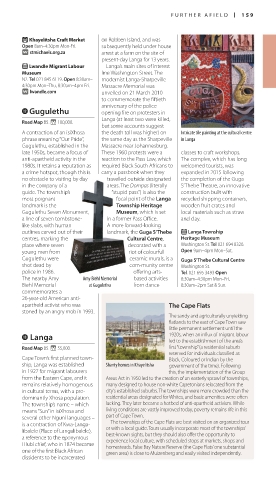
A contraction of an isiXhosa the death toll was higher) on Intricate tile painting at the cultural centre
phrase meaning “Our Pride”, the same day as the Sharpeville in Langa
Gugulethu, established in the Massacre near Johannesburg.
late 1950s, became a focus of These 1960 protests were a classes to craft workshops.
anti-apartheid activity in the reaction to the Pass Law, which The complex, which has long
1980s. It retains a reputation as required Black South Africans to welcomed tourists, was
a crime hotspot, though this is carry a passbook when they expanded in 2015 following
no obstacle to visiting by day travelled outside designated the completion of the Guga
in the company of a areas. The Dompas (literally S’Thebe Theatre, an innovative
guide. The township’s “stupid pass”) is also the construction built with
most poignant focal point of the Langa recycled shipping containers,
landmark is the Township Heritage wooden fruit crates and
Gugulethu Seven Monument, Museum, which is set local materials such as straw
a line of seven tombstone- in a former Pass Office. and clay.
like slabs, with human A more forward-looking
outlines carved out of their landmark, the Guga S’Thebe E Langa Township
centres, marking the Cultural Centre, Heritage Museum
place where seven decorated with a Washington St. Tel 021 694 8320.
young men from riot of colourful Open 9am–4pm Mon–Sat.
Gugulethu were ceramic murals, is a Guga S’Thebe Cultural Centre
shot dead by com-munity centre Washington St.
police in 1986. offering arts- Tel. 021 695 3493 Open
The nearby Amy Amy Biehl Memorial based activities 8:30am–4:30pm Mon–Fri,
Biehl Memorial at Gugulethu from dance 8:30am–2pm Sat & Sun.
commemorates a
26-year-old American anti-
apartheid activist who was The Cape Flats
stoned by an angry mob in 1993.
The sandy and agriculturally unyielding
flatlands to the east of Cape Town saw
little permanent settlement until the
e Langa 1920s, when an influx of migrant labour
led to the establishment of the area’s
Road Map B5. * 55,000. first “township” (a residential suburb
reserved for individuals classified as
Cape Town’s first planned town- Black, Coloured or Indian by the
ship, Langa was established Shanty homes in Khayelitsha government of the time). Following
in 1927 for migrant labourers this, the implementation of the Group
from the Eastern Cape, and it Areas Act in 1950 led to the creation of an easterly sprawl of townships,
remains relatively homogenous many designed to house non-white Capetonians relocated from the
in cultural terms, with a pre- city’s established suburbs. The townships were more crowded than the
dominantly Xhosa population. residential areas designated for Whites, and basic amenities were often
The township’s name – which lacking. They later became a hotbed of anti-apartheid activism. While
means “Sun” in isiXhosa and living conditions are vastly improved today, poverty remains rife in this
several other Nguni languages – part of Cape Town.
is a contraction of Kwa-Langa- The townships of the Cape Flats are best visited on an organized tour
libalele (Place of Langalibalele), or with a local guide. Tours usually incorporate most of the townships’
best-known sights, but they should also offer the opportunity to
a reference to the eponymous experience local culture, with scheduled stops at markets, shops and
Hlubi chief, who in 1874 became homesteads. False Bay Nature Reserve (the Cape Flats’ one substantial
one of the first Black African green area) is close to Muizenberg and easily visited independently.
dissidents to be incarcerated
158_159_EW_South_Africa.indd 159 25/05/17 11:59 am

