


Page 166 - (DK Eyewitness) Travel Guide - South Africa
P. 166
164 C APE T OWN
t Kirstenbosch National Botanical Garden
In July 1913, the South African government handed over the
running of Kirstenbosch estate (which had been bequeathed
to the state by Cecil John Rhodes in 1902) to a board of trustees.
The board established a botanical garden that preserves and
propagates rare indigenous plant species. Today, the world-
renowned garden covers an area of 5.3 sq km (2 sq miles), of which
7 per cent is cultivated and 90 per cent is covered by natural fynbos
and forest. Kirstenbosch is spectacular from August to October
when the garden is ablaze with spring daisies and gazanias.
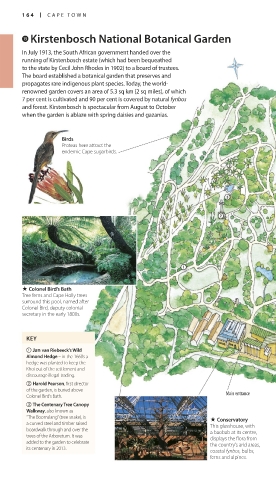
Birds
Proteas here attract the
endemic Cape sugarbirds.
. Colonel Bird’s Bath
Tree ferns and Cape Holly trees
surround this pool, named after
Colonel Bird, deputy colonial
secretary in the early 1800s.
KEY
1 Jan van Riebeeck’s Wild
Almond Hedge – in the 1660s a
hedge was planted to keep the
Khoi out of the settle ment and
discourage illegal trading.
2 Harold Pearson, first direc tor
of the garden, is buried above Main entrance
Colonel Bird’s Bath.
3 The Centenary Tree Canopy
Walkway, also known as
“The Boomslang” (tree snake), is . Conservatory
a curved steel and timber raised This glasshouse, with
boardwalk through and over the a baobab at its centre,
trees of the Arboretum. It was displays the flora from
added to the garden to celebrate the country’s arid areas,
its centenary in 2013. coastal fynbos, bulbs,
ferns and alpines.
164-165_EW_South_Africa.indd 164 25/05/17 2:46 pm

