


Page 204 - (DK Eyewitness) Travel Guide - South Africa
P. 204
202 THE WESTERN AND SOUTHERN C APE
6 Boschendal Manor House
In 1685, Simon van der Stel granted the land on which the
manor house stands to the French Huguenot, Jean le Long.
Originally named “Bossendaal” (which literally means “forest
and valley”), the property was transferred in 1715, together with
adjacent fertile farmland, to another Huguenot settler, Abraham
de Villiers. It remained in the wine-farming de Villiers family for
100 years. Jan de Villiers built the wine cellar and coach house
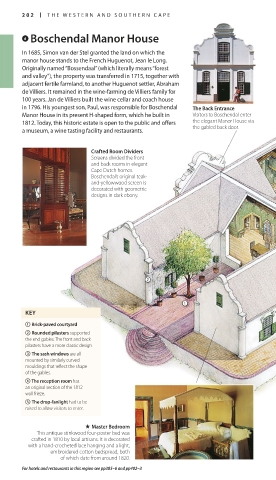
in 1796. His youngest son, Paul, was responsible for Boschendal The Back Entrance
Manor House in its present H-shaped form, which he built in Visitors to Boschendal enter
1812. Today, this historic estate is open to the public and offers the elegant Manor House via
the gabled back door.
a museum, a wine tasting facility and restaurants.
Crafted Room Dividers
Screens divided the front
and back rooms in elegant
Cape Dutch homes.
Boschendal’s original teak-
and-yellowwood screen is
decorated with geometric
designs in dark ebony.
KEY
1 Brick-paved courtyard
2 Rounded pilasters supported
the end gables. The front and back
pilasters have a more classic design.
3 The sash windows are all
mounted by similarly curved
mouldings that reflect the shape
of the gables.
4 The reception room has
an original section of the 1812
wall frieze.
5 The drop-fanlight had to be
raised to allow visitors to enter.
. Master Bedroom
This antique stinkwood four-poster bed was
crafted in 1810 by local artisans. It is decorated
with a hand-crocheted lace hanging and a light,
embroidered cotton bedspread, both
of which date from around 1820.
For hotels and restaurants in this region see pp385–6 and pp402–3
202-203_EW_South_Africa.indd 202 25/05/17 11:59 am

