


Page 213 - (DK Eyewitness) Travel Guide - South Africa
P. 213
THE WESTERN AND SOUTHERN C APE 211
THE WEST COAST
The dry, sunbaked landscape of South Africa’s west
coast is bounded to the east by the rugged Cederberg
moun tain range and to the west by the rocky, wind-blown
Atlantic coastline. Attractions in the region are manyfold:
charming fishing villages, bleached-white beaches, delectable
seafood, whale-watching and hiking. An unexpected surprise in
this forbidding terrain is the appearance every spring of colourful
fields of exquisite wildflowers.
The West Coast extends north of Cape The upwelling of the Atlantic Ocean’s cold
Town to the Namibian border, where the Benguela Current along the coast brings
fringes of the Namib desert epito mize the rich phytoplanktonic nutrients to the
extremes of this vast, rain-deprived area. surface, attracting vast shoals of pelagic
The arid, bleak and infertile veg etation fish. This harvest from the sea supports an
zones support only hardy, drought- important fish ing industry in the Western
resistant succulents and geophytes Cape. Saldanha Bay, a rather unappealing
(plants whose bulbs, corms or tubers industrial town, is the fishing and seafood
store water and nutri ents). The fynbos area processing hub. It is also a major centre
south of Nieu woudtville possesses a stark for the export of iron ore, which is mined
beauty, embodied in the weird forms of at Sishen, further inland in the Northern
the Cederberg’s outcrops that were Cape Province. Sishen is the site of the
eroded over millennia by wind and rain. largest iron ore deposits in the world.
Further inland the country’s wheat belt The Namaqualand is an arid belt
centres on Malmesbury, and is an area of stretching north of the Cederberg almost
undulating golden corn whose texture to the Namibian border, which is marked
changes constantly with the play of light by the mighty Orange River. This belt only
on the rippling fields. Also in the interior receives about 140 mm (6 inches) of
are the West Coast wine farms around the rainfall during March and April, but the
Swartland and Sandveld. Here, the good brief downpours provide sufficient
soils, combined with a low level of rain moisture to blanket the landscape with
and warm summers, create rich and colourful blooms from August to
earthy flavours in the wines. October every year.
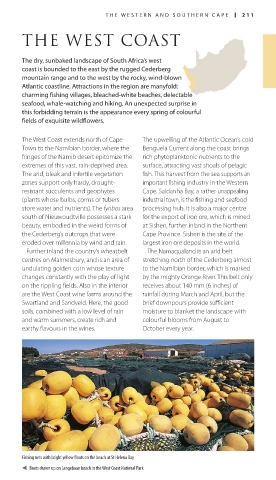
Fishing nets with bright yellow floats on the beach at St Helena Bay
Boats drawn up on Langebaan beach in the West Coast National Park
210-211_EW_South_Africa.indd 211 21/05/2015 11:46

