


Page 302 - (DK Eyewitness) Travel Guide - South Africa
P. 302
300 THE EAST C O AST AND INTERIOR
8 iSimangaliso Wetland Park in December. Between St Lucia
and Cape Vidal, the Eastern
Chosen as South Africa’s first UNESCO World Heritage Site in Shores sector has some of the
1999, the 3,320-sq-km (1,282-sq-mile) iSimangaliso Wetland world’s tallest forest dunes, and
Park is the country’s third-largest protected area and easily its resident wildlife includes several
types of antelope. A game-
most biodiverse. Nelson Mandela once described it as “the only viewing loop to Lake Bhangazi
place on the globe where the oldest land mammal (rhinoceros) offers a chance of sighting
and the world’s biggest terrestrial mammal (elephant) share buffalo, rhino, elephant and
an ecosystem with the world’s oldest fish (coelacanth) and the cheetah.
world’s biggest marine mammal (whale).”
uMkhuze Game Reserve
Created in 1912, this 400 sq km
(154 sq miles) inland spur of
iSimangaliso offers excellent
game viewing, with substantial
numbers of rhino, elephant,
giraffe and antelope. Wildlife
photographers frequent the trio
of well-sited hides overlooking
shallow pans that attract a
stream of nyala, kudu, zebra and
other large mammals. The park is
also known for its birdlife, with
more than 420 species recorded.
Nsumo Pan, encircled by yellow-
St Lucia Estuary offers excellent shore-based fishing fever trees and low hills, is an
excellent spot for water birds,
Exploring iSimangaliso urban centre patrolled noctur- while sand forests harbour
Wetland Park nally by hippopotamus, warthog, “iSimangaliso specials” such as
Comprising more than half-a- red duiker, bushbaby and other yellow-spotted nicator, Neer-
dozen separate reserves and small predators. Walking trails gard’s sunbird and African
sanctuaries, iSimangaliso – a Zulu starting from the village offer broadbill. Geared mainly to self-
phrase meaning “something excellent birding – notably drivers, uMkhuze offers activities
wondrous”– encompasses a trumpeter hornbill and purple- such as a Fig Forest Walk near
diverse range of habitats, from crested turaco – while launch Nsumo Pan and a cultural village
Africa’s most southerly coral trips on the estuary provide good providing insights into traditional
reefs to mountains, grassland hippo and crocodile sightings. Zulu lifestyle and crafts.
and coastal forest. The park is The village is flanked by a
particularly suited to self-drive gorgeous sandy beach, while the Sodwana Bay
exploration, ideally basing your- Crocodile Farm to its north is one Located on an unspoiled stretch
self in St Lucia village for a few of the finest in the country. of coast 65 km (41 miles) north of
nights, then striking out to St Lucia, Sodwana Bay is South
some of the isolated rest Africa’s premier scuba desti na-
camps and lodges at more tion, operating all year round,
northerly sites such as though the best conditions for
Sodwana, Sibaya and Kosi diving are from April through to
Bay. Even without your own September. The world’s southern-
vehicle, though, St Lucia most tropical coral reefs lie
makes an excellent base for offshore and are, in most cases,
organized day excursions, named after their imperial
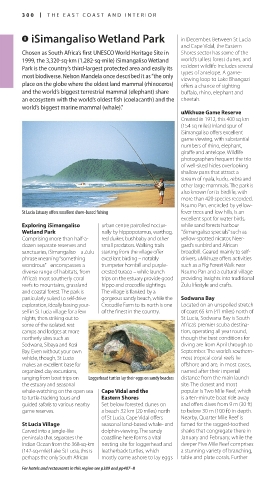
ranging from boat trips on Loggerhead turtles lay their eggs on sandy beaches distance from the main launch
the estuary and seasonal site. The closest and most
whale-watching on the open sea Cape Vidal and the popular is Two Mile Reef, which
to turtle-tracking tours and Eastern Shores is a ten-minute boat ride away
guided safaris to various nearby Set below forested dunes on and offers dives from 9 m (30 ft)
game reserves. a beach 32 km (20 miles) north to below 30 m (100 ft) in depth.
of St Lucia, Cape Vidal offers Nearby, Quarter Mile Reef is
St Lucia Village seasonal land-based whale- and famed for the ragged-toothed
Carved into a jungle-like dolphin-viewing. The sandy sharks that congregate there in
peninsula that separates the coast line here forms a vital January and February, while the
Indian Ocean from the 368-sq-km nesting site for loggerhead and deeper Five Mile Reef comprises
(142-sq-mile) Lake St Lucia, this is leather back turtles, which a stunning variety of branching,
perhaps the only South African mostly come ashore to lay eggs table and plate corals. Further
For hotels and restaurants in this region see p389 and pp407–8
300-301_EW_South_Africa.indd 300 25/05/17 12:00 pm

