


Page 398 - (DK Eyewitness) Travel Guide - South Africa
P. 398
396 TR A VELLERS ’ NEEDS
What to Drink in South Africa
South African wine may be classified as “New World”, but the
country actually has a long history in wine-making. The first
vines were planted in the Cape of Good Hope by Commander
Jan van Riebeeck in 1655. The most important figure in the
industry, however, was Simon van der Stel, who founded both
the Stellenbosch and Constantia vineyards, the latter’s
dessert wine gaining an international reputation by the end
of the 17th century. In 1885, the vineyards were devastated
by an infestation of the phylloxera insect. The subsequent
recovery led to over-production and this, along with
the establishment of trade sanctions as a result of
apartheid, led to a decline in quality. Recent years
have seen major changes in the industry, with a move
towards smaller, independent vineyards producing
some world-class wines. South Africa is now the
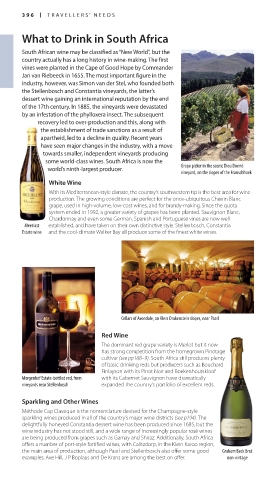
world’s ninth-largest producer. Grape picker in the scenic Dieu Donné
vineyard, on the slopes of the Franschhoek
White Wine
With its Mediterranean-style climate, the country’s southwestern tip is the best area for wine
production. The growing conditions are perfect for the once-ubiquitous Chenin Blanc
grape, used in high-volume, low-cost wines, and for brandy-making. Since the quota
system ended in 1992, a greater variety of grapes has been planted. Sauvignon Blanc,
Chardonnay and even some German, Spanish and Portuguese vines are now well
Meerlust established, and have taken on their own distinctive style. Stellenbosch, Constantia
Estate wine and the cool-climate Walker Bay all produce some of the finest white wines.
Cellars of Avondale, on Klein Drakenstein slopes, near Paarl
Red Wine
The dominant red grape variety is Merlot but it now
has strong competition from the homegrown Pinotage
cultivar (see pp188–9). South Africa still produces plenty
of basic drinking reds but producers such as Bouchard
Finlayson with its Pinot Noir and Boekenhoutskloof
Morgenhof Estate-bottled red, from with its Cabernet Sauvignon have dramatically
vineyards near Stellenbosch expanded the country’s portfolio of excellent reds.
Sparkling and Other Wines
Méthode Cap Classique is the nomenclature devised for the Champagne-style
sparkling wines produced in all of the country’s major wine districts (see p194). The
delightfully honeyed Constantia dessert wine has been produced since 1685, but the
wine industry has not stood still, and a wide range of increasingly popular rosé wines
are being produced from grapes such as Gamay and Shiraz. Additionally, South Africa
offers a number of port-style fortified wines, with Calitzdorp, in the Klein Karoo region,
the main area of production, although Paarl and Stellenbosch also offer some good Graham Beck Brut
examples. Axe Hill, J P Boplaas and De Krans are among the best on offer. non-vintage
396-397_EW_South_Africa.indd 396 25/05/17 2:48 pm

