Page 18 - Fish and Amphibians (Britannica Illustrated Science Library)
P. 18
14 GENERAL CHARACTERISTICS                                                                                                                                                                             FISH AND AMPHIBIANS 15


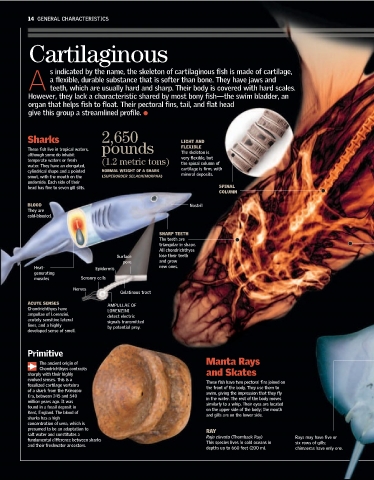
          Cartilaginous


                 s indicated by the name, the skeleton of cartilaginous fish is made of cartilage,
                 a flexible, durable substance that is softer than bone. They have jaws and
          A teeth, which are usually hard and sharp. Their body is covered with hard scales.
          However, they lack a characteristic shared by most bony fish—the swim bladder, an
          organ that helps fish to float. Their pectoral fins, tail, and flat head
          give this group a streamlined profile.


          Sharks                  2,650                    LIGHT AND

          These fish live in tropical waters,  pounds      FLEXIBLE
          although some do inhabit                         The skeleton is
          temperate waters or fresh  (1.2 metric tons)     very flexible, but
          water. They have an elongated,                   the spinal column of                                                                                                 SCALES               HOW IT REPRODUCES
          cylindrical shape and a pointed  NORMAL WEIGHT OF A SHARK   cartilage is firm, with                                                                                   Most of these fish
                                                           mineral deposits.                                                                                                                         The modified pelvic fin
          snout, with the mouth on the  (SUPERORDER SELACHIMORPHA)                                                                                                              have skin with       of the male is its sexual
          underside. Each side of their                                                                                                                                         thousands of         organ. The fin penetrates
          head has five to seven gill slits.                           SPINAL                                                                                                   interlocking scales,  the female, which then
                                                                       COLUMN
                                                                                                                                                                                called denticles or  lays a string of eggs. The
                                                                                                                                                                                placoid scales.      young are not born in
          BLOOD                                               Nostril                                                                                                                                larval form.
          They are
          cold-blooded.
                                                                                                                                                                      IN SOME SHARK SPECIES, THE YOUNG
                                                    SHARP TEETH                                                                                                       DEVELOP WITHIN THE FEMALE, INSIDE A
                                                    The teeth are                                                                                                     STRUCTURE SIMILAR TO A PLACENTA.
                                                    triangular in shape.
                                                    All chondrichthyes
                                       Surface      lose their teeth
                                         pore       and grow
            Heat-               Epidermis           new ones.                                                                                                                   HETEROCERCAL TAIL
            generating                                                                                                                                                          The shark's caudal fin is
            muscles        Sensory cells                                                                                         GILL SLITS                                     small, and the upper
                                                                                                                                 These life-forms                               lobe is larger than the
                                                                                                                                 may have five or
                         Nerves                                                                                                                                                 lower lobe.
                                        Gelatinous tract                                                                         six gill slits.
                                                                                                                                                                                                                           SHARK
          ACUTE SENSES              AMPULLAE OF                                                                                                                                                                            Superorder
          Chondrichthyes have       LORENZINI                                                                                                                                                                              Selachimorpha
          ampullae of Lorenzini,
                                    detect electric                                                                                                                                                                        This X-ray shows the
          acutely sensitive lateral
                                    signals transmitted                                                                                                                                                                    spine and nerves.
          lines, and a highly       by potential prey.
          developed sense of smell.
          Primitive                                                                                                                                                                                   Chimaerae
                                                                   Manta Rays
              The ancient origin of                                                                                                                                                                   Deepwater fish. Like the prehistoric animals, they have
              Chondrichthyes contrasts                                                                                                                                                                large heads and pectoral fins. They have a spine in front
          sharply with their highly                                and Skates                                                                                                                         of the first dorsal fin. The back end of the body
          evolved senses. This is a                                                                                                                                                                         narrows into a tail followed by a
                                                                   These fish have two pectoral fins joined on
          fossilized cartilage vertebra                                                                                                                                                                    thin filament.
                                                                   the front of the body. They use them to
          of a shark from the Paleozoic                            swim, giving the impression that they fly
          Era, between 245 and 540                                 in the water. The rest of the body moves
          million years ago. It was
                                                                   similarly to a whip. Their eyes are located
          found in a fossil deposit in
                                                                   on the upper side of the body; the mouth                                                                                                                   CHIMAERAS
          Kent, England. The blood of
                                                                   and gills are on the lower side.                                                                                                                           Rhinochimaera
          sharks has a high
          concentration of urea, which is                                                                                                                                                                                     pacifica
          presumed to be an adaptation to                          RAY                                                                                                                                                        This fish lives in
          salt water and constitutes a                                                                                                                                                                                        the dark at depths
                                                                   Raja clavata (Thornback Ray)  Rays may have five or                                                                                                        of up to 4,900 feet
          fundamental difference between sharks                                                                                                                                                                               (1,500 m); it is 4
                                                                   This species lives in cold oceans in  six rows of gills;
          and their freshwater ancestors.                                                                                                                                                                                     feet (1.2 m) long.
                                                                   depths up to 660 feet (200 m).  chimaeras have only one.
   13   14   15   16   17   18   19   20   21   22   23