


Page 21 - Fish and Amphibians (Britannica Illustrated Science Library)
P. 21
16 GENERAL CHARACTERISTICS                                                              FISH AND AMPHIBIANS 17


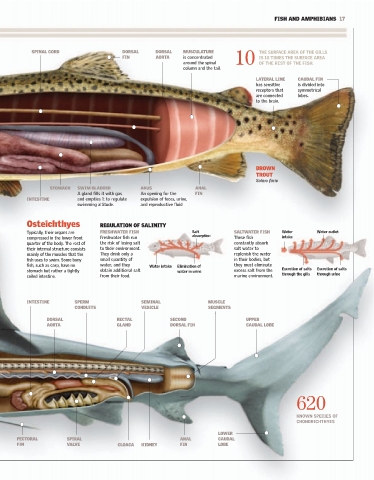
 Anatomy  SIMPLE EYE  BRAIN  SPINAL CORD  DORSAL   DORSAL   MUSCULATURE             THE SURFACE AREA OF THE GILLS
                                                            around the spinal 10
 Each eye focuses to one side;
 receives information
                                        FIN
                                                            is concentrated
                                                   AORTA
                                                                                    IS 10 TIMES THE SURFACE AREA
 there is no binocular vision.  and coordinates all                                 OF THE REST OF THE FISH.
 the fish's actions                                         column and the tail.
 Retina
 ost fish have the same internal organs as amphibians,  Suspensory  and functions.
 ligament                                                                          LATERAL LINE  CAUDAL FIN
 reptiles, birds, and mammals. The skeleton acts as a  Lens  Optic                 has sensitive   is divided into
 nerve
 M support, and the brain receives information through  Iris                       receptors that  symmetrical
                                                                                   are connected  lobes.
 the eyes and the lateral line to coordinate the motions of the                    to the brain.
 muscles in propelling the fish through the water. Fish breathe
 with gills, they have a digestive system designed to
 transform food into nutrients, and they have a heart that
 pumps blood through a network of blood vessels.

 Cyclostomata  THE CURRENT                                                         BROWN
 Its digestive tract is little more than  45  NUMBER OF SPECIES  MOUTH  GILLS      TROUT
 a straight tube extending from its  OF CYCLOSTOMATA  Structures                   Salmo fario
 round, jawless mouth to the anus.  with multiple  HEART  STOMACH  SWIM BLADDER  ANUS  ANAL
 Because of their simplicity,  folds that  receives all
                          A gland fills it with gas  An opening for the  FIN
 many species of lampreys   provide oxygen  the blood and
 LIVER    INTESTINE       and empties it to regulate  expulsion of feces, urine,
 are parasites. They live   EYE  to the blood  pumps it toward
 CAUDAL                   swimming altitude.  and reproductive fluid
 off the blood of other  the gills.
 fish and have thin  FIN  BREATHING
 pharyngeal   SACS
 sacs instead  ANUS  Osteichthyes  REGULATION OF SALINITY
 of gills.                       FRESHWATER FISH               Salt         SALTWATER FISH  Water      Water outlet
 HEART    Typically, their organs are                          absorption
          compressed in the lower front  Freshwater fish run                These fish      intake
          quarter of the body. The rest of  the risk of losing salt         constantly absorb
 FIRST                           to their environment.                      salt water to
 LIVER    their internal structure consists
 DORSAL
          mainly of the muscles that the  They drink only a                 replenish the water
 FIN
          fish uses to swim. Some bony  small quantity of                   in their bodies, but
 TOOTHED  fish, such as carp, have no  water, and they  Water intake  Elimination of  they must eliminate
 MOUTH    stomach but rather a tightly  obtain additional salt  water in urine  excess salt from the  Excretion of salts  Excretion of salts
          coiled intestine.      from their food.                           marine environment.  through the gills  through urine
 LAMPREY
 Lampetra sp.  INTESTINE
 SUPPORT FOR  NOTOCHORD  INTESTINE  SPERM     SEMINAL               MUSCLE
 PHARYNGEAL SACS         CONDUITS             VESICLE               SEGMENTS
 TESTICLES
                DORSAL                 RECTAL           SECOND                  UPPER
                AORTA                  GLAND            DORSAL FIN              CAUDAL LOBE
 VERTEBRAE
 STOMACH
 BRAIN
 RIGHT
 KIDNEY
 GONAD


                                                                                                620
 Chondrichthyes
 A shark has the same organic                                                                   KNOWN SPECIES OF
 structures as a bony fish, except for                                                          CHONDRICHTHYES
 NASAL PIT
 the swim bladder. A shark also has a
 corkscrew-like structure called a spiral                              LOWER
 valve at the end of its intestine to  SHARK  GILL  PECTORAL  SPIRAL  ANAL  CAUDAL
 increase the surface area for
 Carcharodon sp.  MOUTH  SLITS  HEART  LIVER  STOMACH  FIN  VALVE  CLOACA  KIDNEY  FIN  LOBE
 absorption of nutrients.

