


Page 36 - Fish and Amphibians (Britannica Illustrated Science Library)
P. 36
32 LIFE IN THE WATER FISH AND AMPHIBIANS 33
Life Cycle BODY OF Parents
THE FRY
The yellow-headed jawfish,
n an underwater environment, animals can simply secrete their sex cells into the water. But for YOUNG BODY OF Opisthognathus aurifrons,
fertilization to be effective, the male and the female must synchronize their activities. Many 3 FISH (FRY) THE FRY incubates its eggs inside
its mouth.
I species, such as the salmon, travel great distances to meet with potential mates. Upon meeting 121 DAYS
a mate they release their sex cells. The time and place are important because the survival of the The small fry feed
from the yolk sac.
eggs depends on the water temperature. Parent-child relations are extremely varied, from complete Mouth Incubation
neglect of the eggs once laid to constant watchfulness and protection of the young. The gestation of some fish species takes place
inside the parents' mouths. They incubate the
eggs inside their mouths and then spit them out
into the burrow. Once the eggs hatch, the
parents protect their young by sheltering them
again inside their mouths.
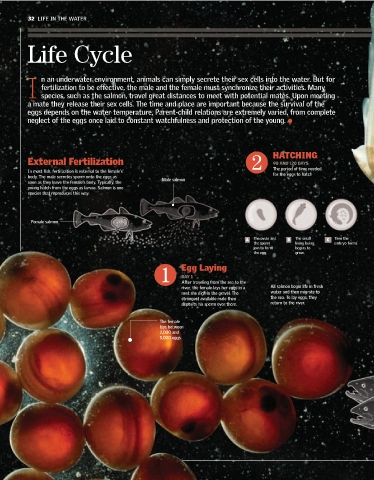
External Fertilization 2 HATCHING Internal Fertilization
90 AND 120 DAYS
In most fish, fertilization is external to the female's The period of time needed FRY'S Viviparous fish give birth to their young in the
for the eggs to hatch
body. The male secretes sperm onto the eggs as YOLK SAC
Male salmon form of developed juveniles. Fertilization is
soon as they leave the female's body. Typically, the
internal, carried out by a male organ called the
young hatch from the eggs as larvae. Salmon is one gonopod, which is a modified fin.
species that reproduces this way.
Paraplacental
Ovary
uterine space
Female salmon
The ovule and The small Then the Umbilical cord
A B C 6 Year
the sperm living being embryo forms.
join to form begins to Placenta
the egg. grow. Cycle
This is the life
1 Egg Laying span of a salmon.
DAY 1
After traveling from the sea to the
river, the female lays her eggs in a All salmon begin life in fresh
nest she digs in the gravel. The water and then migrate to
strongest available male then the sea. To lay eggs, they
deposits his sperm over them. return to the river.
The female 4 Juveniles
2 years
lays between Salmon fry grow until they
2,000 and
become small juvenile salmon.
5,000 eggs. Adults They migrate to the sea, where
5 6 years they live for four years. Young male
The adult salmon have fully
mature reproductive organs, and
they return to the river where Young female
they were born to lay their eggs.
Urogenital
Ovary opening

