Page 38 - Fish and Amphibians (Britannica Illustrated Science Library)
P. 38
34 LIFE IN THE WATER                                                                                                                                                                                   FISH AND AMPHIBIANS 35


          Matters of Life and Death                                                                                                                                                                         They reach
                                                                                                                                  Flying Fish
                                                                                                                                                                                      2
                                                                                                                                                                       1
                                                                                                                                                                                                          heights of up to
                                                                                                                                                                                                           19 feet (6 m).
                                                                                                                                  Exocoetidae, or flying fish, are a family of  ESCAPE  TAKEOFF
               o survive, most fish need adaptations to enable them to flee from their                                             ocean fish that includes 52 species grouped  When a predator  The fish comes to the
                                                                                                                                                                      appears, the flying fish
                                                                                                                                                                                     surface and elevates
                                                                                                                                     in eight genera. They are found in all the  propels itself out of  itself as high as it can,
               predators or to find food. The European plaice can lie on the ocean floor                                               oceans, especially in warm tropical  the water.  skipping over the water.     3  GLIDING
         T with its flat body. Its ivory color makes it almost invisible. The                                                            and subtropical waters. Their most                                            The average gliding distance is
                                                                                                                                                                                                                       160 feet (50 m), but they can
                                                                                                                                           surprising characteristic is their
         flying fish, on the other hand, developed pectoral fins to lift itself                                                             unusually large pectoral fins,                                             glide as far as 660 feet (200 m).
         up over the surface of the water and flee its enemies.                                                                               which give them the ability
                                                                                                                                               to fly and glide for
                                                                                                                                                short distances.
                                                                                                                                                                                                      These fish cover distances of up to 160 feet (50 m) in the air.
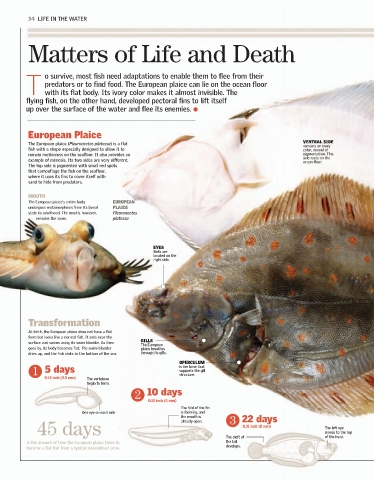
          European Plaice
                                                                                                  VENTRAL SIDE                                                        Flying fish measure from
          The European plaice (Pleuronectes platessa) is a flat                                                                                                                                        ANATOMY
                                                                                                  remains an ivory                                                       7 to 18 inches
          fish with a shape especially designed to allow it to                                    color, devoid of                                                      (18 to 45 cm) long.            This fish slides over the
          remain motionless on the seafloor. It also provides an                                  pigmentation. This                                                                                   water with its hardened
          example of mimesis. Its two sides are very different.                                   side rests on the                                                                                    fins, and it can reach
                                                                                                  ocean floor.
          The top side is pigmented with small red spots                                                                                                                                               speeds up to 40 miles
          that camouflage the fish on the seafloor,                                                                                                                                                    per hour (65 km/h) for
          where it uses its fins to cover itself with                                                                                                                                                  as long as 30 seconds.
          sand to hide from predators.
                                                                                                                                                                                                       This fish has
          MOUTH                                                                                                                                                                                        highly developed
          The European plaice's entire body  EUROPEAN                                                                                                                                                  pectoral and
          undergoes metamorphosis from its larval  PLAICE                                                                                                                                              pelvic fins.
          state to adulthood. The mouth, however,   Pleuronectes
             remains the same.       platessa
                                                                                                                                                                                                         FLYING FISH
                                                                                                                                                                                                         Exocoetus volitans
                                                  EYES                                                                                                   SPOTS
                                                  Both are                                                                                               are useful for
                                                  located on the                                                                                         camouflage in the
                                                  right side.                                                                                            sand and for hiding
                                                                                                                                                         from its predators.
                                                                                                                                                                                                     Scorpion Fish
                                                                                                                                                                                                     Found in the reefs of the Gulf of Mexico, Scorpaena
                                                                                                                                                                                                     plumieri, known commonly as the scorpion fish, has a
                                                                                                                                                                                                     brown, spotted body with many appendages that look
                                                                                                                                                                                                     like moss between its mouth and its eyes. This fish is
                                                                                                                                                                                                     hard to see because its texture and color help it blend
                                                                                                                                                                                                     easily into the seafloor. Its dorsal fins have a powerful
          Transformation                                                                                                                                                                             venom, which causes intense pain.
          At birth, the European plaice does not have a flat
          form but looks like a normal fish. It eats near the
          surface and swims using its swim bladder. As time  GILLS
                                              The European
          goes by, its body becomes flat. The swim bladder  plaice breathes
          dries up, and the fish sinks to the bottom of the sea.  through its gills.
                                                           OPERCULUM                                                                            FIN              CAUDAL FIN
                                                                                                                                                The dorsal, anal, and
                                                           is the bone that
           1   5 days                                      supports the gill                                                                    caudal fins form a  Thin, barely used    SCORPION FISH
                                                                                                                                                                 for swimming.
                                                           structure.
               0.14 inch (3.5 mm)  The vertebrae                                                                                                continuous line                          Scorpaena plumieri
                                                                                                                                                around the body.
                             begin to form.
                                            2   10 days
                                                 0.15 inch (4 mm)
                                                                                                                                                     The pigment cells join
                                                           The fold of the fin                                                        45 days        to form dark spots.
                           One eye on each side            is forming, and                                                        4
                                                           the mouth is                                                               0.43 inch (11 mm)
                                                           already open.   3   22 days
             45 days                                                           0.31 inch (8 mm)          The left eye                                                It no longer
                                                                                                                                                                     looks to the
                                                                                                         moves to the top
                                                                          The cleft of                   of the head.                                                right, but
          is the amount of time the European plaice takes to              the tail                                                                                   upward.
                                                                          develops.
          become a flat fish from a typical streamlined larva.
   33   34   35   36   37   38   39   40   41   42   43