


Page 60 - Fish and Amphibians (Britannica Illustrated Science Library)
P. 60
56 DIVERSITY FISH AND AMPHIBIANS 57
Sea Snakes VISION SMELL How It Attacks Its Prey
Very poor
Highly
developed. This
sense is used to Hiding place
detect prey. A It lives in crevices
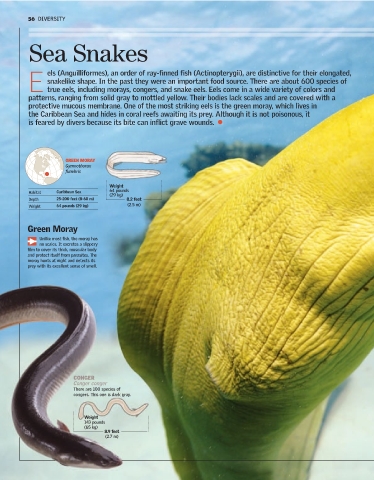
els (Anguilliformes), an order of ray-finned fish (Actinopterygii), are distinctive for their elongated, and caves in coral
reefs, where it peers
snakelike shape. In the past they were an important food source. There are about 600 species of out, waiting to Prey
pounce on its prey.
E true eels, including morays, congers, and snake eels. Eels come in a wide variety of colors and
patterns, ranging from solid gray to mottled yellow. Their bodies lack scales and are covered with a
protective mucous membrane. One of the most striking eels is the green moray, which lives in Attack It slashes the
B At night it detects its
the Caribbean Sea and hides in coral reefs awaiting its prey. Although it is not poisonous, it prey (fish and prey with its
teeth.
is feared by divers because its bite can inflict grave wounds. octopuses). It traps
them with its sharp
teeth, which slant
backward to keep the
prey from escaping.
MOUTH
GREEN MORAY Coiling
Gymnothorax C After gulping down
funebris the animal whole,
Upper jaw the eel forms two
has a double curls with its body
row of teeth. to crush and flatten It crushes the
Weight the prey in its prey with its
Habitat Caribbean Sea 64 pounds digestive tract. body.
(29 kg)
Depth 25-200 feet (8-60 m) 8.2 feet
Weight 64 pounds (29 kg) (2.5 m) Lower jaw
has only one
600
row of teeth.
Green Moray species of eel exist
in the world.
Unlike most fish, the moray has Total number
no scales. It excretes a slippery 27 of teeth
film to cover its thick, muscular body
and protect itself from parasites. The
moray hunts at night and detects its
Its two-colored
prey with its excellent sense of smell.
BLUE RIBBON EEL body lacks scales.
Rhinomuraena quaesita
inhabits the waters of the Indian
and Pacific oceans and feeds on
small fish. Females have a yellow
dorsal fin.
FINLESS
Its elongated, muscular
body lacks pectoral and
pelvic fins. Its long
dorsal and anal fins,
however, end in a short Weight
tail fin. 8 pounds
(3.6 kg)
40 inches
(1 m)
CONGER
Conger conger
There are 100 species of
congers. This one is dark gray.
Weight
143 pounds
(65 kg) SNOWFLAKE MORAY
8.9 feet Echidna nebulosa
(2.7 m) Weight Its dark-brown and
53 pounds It grows rather slowly and yellow body is covered
(24 kg) can take up to two years to with a protective
31 inches reach adult size. mucous layer.
(80 cm)

