


Page 63 - Fish and Amphibians (Britannica Illustrated Science Library)
P. 63
58 DIVERSITY                                                                            FISH AND AMPHIBIANS 59


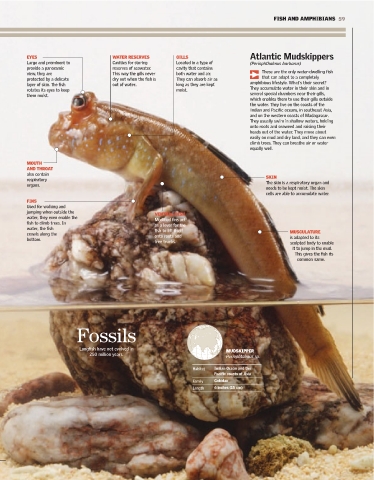
 Out of the Water  EYES              WATER RESERVES       GILLS                  Atlantic Mudskippers

          Large and prominent to     Cavities for storing  Located in a type of  (Periophthalmus barbarus)
          provide a panoramic        reserves of seawater.  cavity that contains
 ome species of fish can breathe and live out of the water. They include the mudskippers  view, they are  This way the gills never  both water and air.  These are the only water-dwelling fish
                                                                                     that can adapt to a completely
          protected by a delicate    dry out when the fish is  They can absorb air as
 in southeast Asia, which can stay on muddy flats and even climb trees. To breathe, they  layer of skin. The fish  out of water..  long as they are kept  amphibious lifestyle. What's their secret?
 S need only their skin to stay moist, thanks to the function of certain cells in their skin. A  rotates its eyes to keep  moist.  They accumulate water in their skin and in
                                                                                 several special chambers near their gills,
          them moist.
 few other species still have rudimentary lungs like those of the first aquatic animals that  which enables them to use their gills outside
                                                                                 the water. They live on the coasts of the
 colonized dry land.                                                             Indian and Pacific oceans, in southeast Asia,
                                                                                 and on the western coasts of Madagascar.
                                                                                 They usually swim in shallow waters, holding
                                                                                 onto roots and seaweed and raising their
                                                                                 heads out of the water. They move about
                                                                                 easily on mud and dry land, and they can even
 Fish with Lungs                                                                 climb trees. They can breathe air or water
 SOUTH AMERICAN LUNGFISH                                                         equally well.
 Lungfish have rudimentary lungs that  Lepidosiren paradoxa
 originate from a connection between the
 swim bladder and the esophagus. This allows  has a small gill apparatus and two  MOUTH
 lungs with which it breathes during
 the swim bladder to function using air when the  the dry season..  AND THROAT
 fish leaves the water. Depending on the species,  also contain
 the fish can breathe air occasionally or even  respiratory                           SKIN
 indefinitely. Many varieties of these fish have  WEST AFRICAN LUNGFISH   organs.     The skin is a respiratory organ and
 been found in fossil form all over the world,  Protopterus annectens annectens       needs to be kept moist. The skin
 which indicates that they were very widespread  has fleshy fins that look like limbs  cells are able to accumulate water.
 during the Mesozoic Era. They were probably  and three external gills. In the dry  FINS
 the first vertebrates to develop lungs. However,  season it secretes a substance for  Used for walking and
 lungfish species are found in only three areas  covering itself. It can remain in this  jumping when outside the  VENTRAL DISK
 today, all in freshwater environments.  state for up to a year.  water, they even enable the  Modified fins act
          fish to climb trees. In                  as a lever for the
          water, the fish
                                                   fish to lift itself                        MUSCULATURE
          crawls along the
 9 months  QUEENSLAND LUNGFISH   bottom.           onto roots and                             is adapted to its
                                                   tree trunks.
                                                                                              sculpted body to enable
 Neoceratodus forsteri
 When forced to breathe air for long                                                           it to jump in the mud.
 Length of time certain                                                                         This gives the fish its
 periods, this fish will die. It can
 lungfish can live buried in  reach up to 50 inches (1.25 m) long,                              common name.
 the mud  weigh 22 pounds (10 kg), and live
 more than 65 years..
 1  WATER LEVELS DROP         2  HEAD FIRST  3  TURNING AROUND  4  HIBERNATION
 The fish looks for an area  On entering the burrow head  The lungfish curls in on itself  The fish breathes through
 with soft mud under the  first, the fish secretes thick  with its head up. Before the  two or three small holes in
 water, where it can easily  mucus, which enables it to slide  water level drops, it seals the  the plug. Its bodily functions
 dig itself a burrow.  in easily and also protects it  entry with a plug of clay.  are reduced to a minimum.
 from dehydration.
                          Fossils


                           Lungfish have not evolved in
 Some water is still          250 million years.                          MUDSKIPPER
 left in the pond.  The water                                             Periophtalmus sp.
 has receded
 completely.
                                                               Habitat  Indian Ocean and the
                                                                      Pacific coasts of Asia
                                                               Family  Gobidae
                                                               Length  6 inches (15 cm)


 In the Mud  Mud  Mud
 When the dry season arrives, and rivers and
 ponds dry up, both the African and South
 American species of lungfish dig holes in the mud
 along the shore and bury themselves. They then reduce
 their metabolic functions to a minimum and burn as
 little energy as possible until the waters rise again.

