Page 55 - World of Animals - Issue #39
P. 55
Tapirs: guardians of the rainforest


                                                                                             Slow breeders
                                                                                             Tapir pregnancies last longer than a year
                                                                                             Tapirs are well known for their slow reproductive
                                                                                             rates. For all species, a gestation period may
                                                                                             last from 12 to 13 months. Tapirs give birth to
                                                                                             one youngster at a time, with twins being born
                                                                                             rarely. Tapirs may give birth once every other
                                                                                             year, though there may be even longer periods
                                                                                             between births. If you compare this to a similar-
                                                                                             sized animal, the pig, which can produce up to 12
                                                                                             piglets a year, it becomes clear that tapirs have a
                                                                                             very slow reproductive cycle.
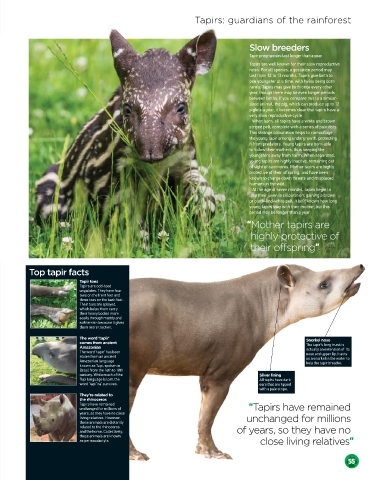
                                                                                              When born, all tapirs have a white and brown
                                                                                             striped pelt, complete with a series of pale dots.
                                                                                             This strange colouration helps to camouflage

                                                                                             the young tapir among undergrowth, protecting
                                                                                             it from predators. Young tapirs are born able
                                                                                             to follow their mothers, thus keeping the
                                                                                             youngsters away from harm. When separated,
                                                                                             young tapirs are highly inactive, remaining out
                                                                                             of sight of carnivores. Mother tapirs are highly

                                                                                             protective of their offspring, and have been
                                                                                             known to charge down threats and misplaced
                                                                                             humans in the wild.
                                                                                              At the age of seven months, tapirs begin to
                                                                                             lose their juvenile colouration, gaining a brown
                                                                                             or black-and-white pelt. It isn’t known how long
                                                                                             young tapirs stay with their mother, but this
                                                                                             period may be longer than a year.
                                                                                            “Mother tapirs are

                                                                                             highly protective of
                                                                                             their offspring”


               Top tapir facts
                                 Tapir toes
                                 Tapirs are odd-toed
                                 ungulates. They have four
                                 toes on the front feet and
                                 three toes on the back feet.
                                 Their toes are splayed,
                                 which helps them carry
                                 their heavy bodies more
                                 easily through muddy and
                                 soƒ terrain because it gives

                                 them more traction.
                                 The word ‘tapir’                                                                Snorkel nose
                                 comes from ancient                                                              The tapir’s long trunk is
                                 Amazonian                                                                       actually an extension of  its
                                 The word ‘tapir’ has been                                                       nose and upper lip. It acts
                                 stolen from an ancient                                                          as a snorkel in the water to
                                 Amazonian language                                                              help the tapir breathe.
                                 known as Tupi, spoken in
                                 Brazil from the 16th to 18th
                                 century. While much of the                                     Silver lining
                                 Tupi language is lost, the                                     All tapirs have dark
                                 word ‘tapi’ira’ survives.                                      ears that are tipped
                                                                                                with a pale stripe.
                                 They’re related to
                                 the rhinoceros
                                 Tapirs have remained                                        “Tapirs have remained
                                 unchanged for millions of
                                 years, so they have no close
                                 living relatives. However,                                 unchanged for millions
                                 these animals are distantly
                                 related to the rhinoceros                              of years, so they have no
                                 and the horse. Collectively,
                                 these animals are known
                                 as perissodactyls.                                              close living relatives”


                                                                                                                               55


       052-056 WOA39_Tapirs.indd   55                                                                                        12/10/2016   15:06
   50   51   52   53   54   55   56   57   58   59   60