


Page 50 - World of Animals - Issue #39
P. 50
All about the common ostrich


            Disappearing land


            These tough birds may be strong enough to look after themselves, but what will
            happen when humans leave them nowhere to go?
            Ostrich populations are relatively widespread. They have   the number of wild ostriches has been decreasing.
            an extremely large range and are found throughout   Alongside this, large expanses of ostrich habitat is being
            much of Africa. This is, in part, due to their hardy   lost at an alarming rate.
            stomachs, their unfussy diet and an ability to go for   As the human population grows, so does the demand
            long periods of time without access to water.    for resources, not to mention land for agricultural use
              Although ostriches are not considered to be   or homes. This encroachment means ostriches are not
            endangered – or even vulnerable – their general   able to roam as freely as they once did, and that can
            population trend has been on the decline for some   impact the species by restricting flock sizes and limiting

            time now. Ostrich farming is now fairly common and   reproductive success in the long term.
            preserves the species in a captive sense, but wild   The level of decline may not be alarming
            ostriches are losing land fast.              conservationists just yet, but humans are putting
              It is unknown exactly how many ostriches remain in   pressure on ostrich populations and it’s certainly
            the wild, but hunting for meat and feathers has meant   something to be monitored for the future.
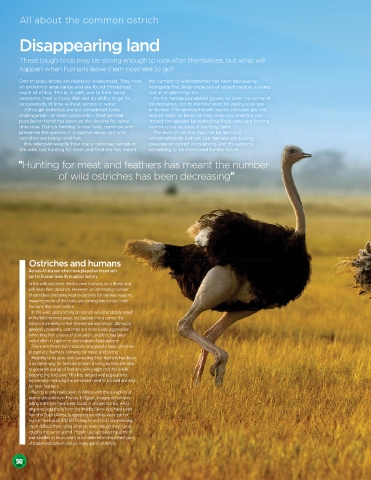
            “Hunting for meat and feathers has meant the number

                          of wild ostriches has been decreasing”


               Ostriches and humans
               Across Africa ostriches have played an important
               part in human lives throughout history
               In the wild ostriches tend to view humans as a threat and
               will keep their distance. However, an increasing number
               of ostriches are being kept in captivity for various reasons,
               meaning more of the birds are coming into contact with
               humans than ever before.
                In the wild, approaching an ostrich would probably result
               in the bird running away, but backed into a corner the
               bird is more likely to feel threatened and attack. Although
               generally peaceful, ostriches are notoriously aggressive
               when they feel unsure of a situation, and this has been

               noted o en in captive or domesticated populations.
                There are three main reasons why people keep ostriches
               in captivity: feathers, farming for meat, and racing.
                Keeping birds alive and harvesting their feathers has been
               a lucrative way for farmers to earn a living as they are able
               to generate a crop of feathers every eight months while
               keeping the bird alive. This has helped wild populations
               immensely, reducing the perceived need to kill wild animals
               for their feathers.
                Racing is only really seen in Africa, with the exception of
               tourist attractions in Florida. In Egypt, images of humans
               riding ostriches have been found in ancient tombs, while
               engraved eggshells from the Middle Stone Age have been
               found in South Africa, suggesting ostriches were part of
               human lives in 60,000 BP. Riding an ostrich is considerably

               more diffi cult than riding a horse, even though they run at
               roughly the same speed. People use specialist equipment
               and saddles to do so and it is considered an important part
               of traditional culture across many parts of Africa.

           50


       044-051_AA Ostrich.indd   50                                                                                          12/10/2016   15:04

