


Page 74 - World of Animals - Issue #39
P. 74
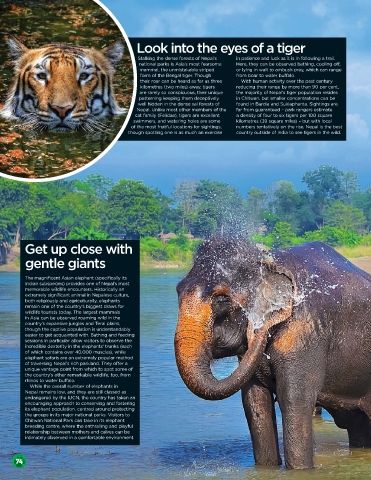
Look into the eyes of a tiger


                                                      Stalking the dense forests of Nepal’s   in patience and luck as it is in following a trail.
                                                      national parks is Asia’s most fearsome   Here, they can be observed bathing, cooling off,
                                                      mammal, the unmistakable striped   or lying in wait to ambush prey, which can range
                                                      form of the Bengal tiger. Though   from boar to water buffalo.
                                                      their roar can be heard as far as three   With human activity over the past century
                                                      kilometres (two miles) away, tigers   reducing their range by more than 90 per cent,
                                                      are rarely so conspicuous, their unique   the majority of Nepal’s tiger population resides
                                                      patterning keeping them deceptively   in Chitwan, but smaller concentrations can be
                                                      well hidden in the dense sal forests of   found in Bardia and Suklaphanta. Sightings are
                                                     Nepal. Unlike most other members of the   far from guaranteed – park rangers estimate
                                                     cat family (Felidae), tigers are excellent   a density of four to six tigers per 100 square
                                                    swimmers, and watering holes are some   kilometres (39 square miles) – but with local
                                                   of the most fruitful locations for sightings,   numbers tentatively on the rise, Nepal is the best
                                                  though spotting one is as much an exercise   country outside of India to see tigers in the wild.


              Get up close with

              gentle giants


              The magnificent Asian elephant (specifically its
              Indian subspecies) provides one of Nepal’s most
              memorable wildlife encounters. Historically an
              extremely significant animal in Nepalese culture,
              both religiously and agriculturally, elephants
              remain one of the country’s biggest draws for
              wildlife tourists today. The largest mammals
              in Asia can be observed roaming wild in the
              country’s expansive jungles and Terai plains,
              though the captive population is understandably
              easier to get acquainted with. Bathing and feeding
              sessions in particular allow visitors to observe the
              incredible dexterity in the elephants’ trunks (each
              of which contains over 40,000 muscles), while
              elephant safaris are an extremely popular method
              of traversing Nepal’s rich parkland. They offer a
              unique vantage point from which to spot some of
              the country’s other remarkable wildlife, too, from
              rhinos to water buffalo.
                While the overall number of elephants in
              Nepal remains low, and they are still classed as
              endangered by the IUCN, the country has taken an
              encouraging approach to conserving and fostering
              its elephant population, centred around protecting
              the groups in its major national parks. Visitors to
              Chitwan National Park can take in its elephant
              breeding centre, where the enthralling and playful
              relationship between mothers and calves can be
              intimately observed in a comfortable environment.


           74


       072-079_Explore the Earth Nepal.indd   74                                                                             12/10/2016   15:46

