


Page 77 - World of Animals - Issue #39
P. 77
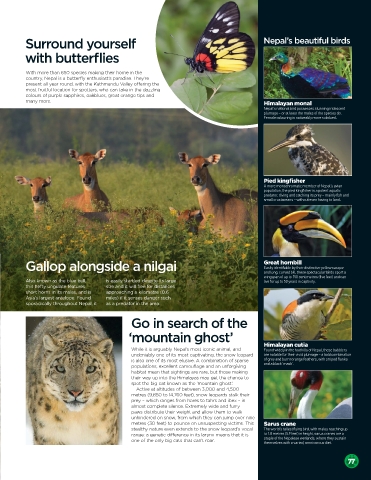
Surround yourself                                                                   Nepal’s beautiful birds

              with butterfl ies


              With more than 650 species making their home in the

              country, Nepal is a butterfly enthusiast’s paradise. They’re
              present all year round, with the Kathmandu Valley offering the
              most fruitful location for spotters, who can take in the dazzling
              colours of purple sapphires, oakblues, great orange tips and
              many more.                                                                          Himalayan monal
                                                                                                  Nepal’s national bird possesses stunning iridescent
                                                                                                  plumage – or at least the males of the species do.
                                                                                                  Female colouring is noticeably more subdued.


                                                                                                  Pied kingfisher

                                                                                                  A more monochromatic member of Nepal’s avian

                                                                                                  population, the pied kingfisher is a potent aquatic

                                                                                                  predator, diving and catching its prey – mainly fish and
                                                                                                  small crustaceans – without even having to land.


              Gallop alongside a nilgai                                                           Great hornbill
                                                                                                  Easily identifiable by their distinctive yellow casque

                                                                                                  and long, curved bill, these spectacular birds sport a

                                                                                                  wingspan of up to 150 centimetres (five feet) and can
              Also known as the blue bull,   is easily startled despite its large                 live for up to 50 years in captivity.

              this hefty ungulate features    size and it will flee for distances
              short horns in its males, and is   approaching a kilometre (0.6
              Asia’s largest antelope. Found   miles) if it senses danger such
              sporadically throughout Nepal, it   as a predator in the area.
                                                   Go in search of the

                                                  ‘mountain ghost’
                                                                                                  Himalayan cutia
                                                   While it is arguably Nepal’s most iconic animal, and   Found widely in the foothills of Nepal, these babblers
                                                   undeniably one of its most captivating, the snow leopard   are notable for their vivid plumage – a bold combination

                                                   is also one of its most elusive. A combination of sparse   of grey and burnt orange feathers, with striped flanks
                                                   populations, excellent camouflage and an unforgiving   and a black ‘mask’.

                                                   habitat mean that sightings are rare, but those making
                                                   their way up into the Himalayas may get the chance to
                                                   spot the big cat known as the ‘mountain ghost’.
                                                     Active at altitudes of between 3,000 and 4,500
                                                   metres (9,850 to 14,760 feet), snow leopards stalk their
                                                   prey – which ranges from hares to tahrs and ibex – in
                                                   almost complete silence. Extremely wide and furry
                                                   paws distribute their weight and allow them to walk
                                                   unhindered on snow, from which they can jump over nine
                                                   metres (30 feet) to pounce on unsuspecting victims. This   Sarus crane
                                                   stealthy nature even extends to the snow leopard’s vocal   The world’s tallest flying bird, with males reaching up

                                                   range: a genetic difference in its larynx means that it is   to 1.8 metres (5.9 feet) in height, sarus cranes are a
                                                   one of the only big cats that can’t roar.      staple of the Nepalese wetlands, where they sustain
                                                                                                  themselves with a varied, omnivorous diet.
                                                                                                                               77


       072-079_Explore the Earth Nepal.indd   77                                                                             12/10/2016   17:46

