


Page 27 - All About History - Issue 27-15
P. 27
Tourism
COMMISSION A PAINTING
In lieu of digital cameras and smartphones, many
gentlemen on the Grand Tour would pen a sketch
of the surrounding sights themselves. However, for
those who could not draw or wished for something
more special, artists were available for commission
to create the perfect visual memento of their
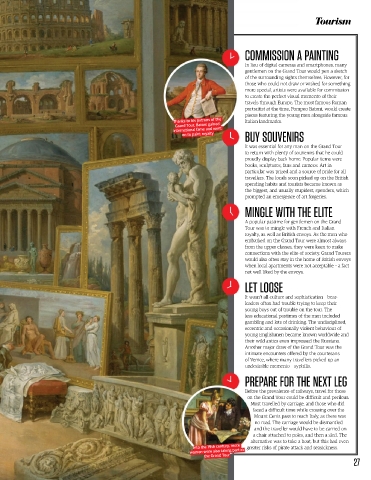
travels through Europe. The most famous Roman
portraitist at the time, Pompeo Batoni, would create
pieces featuring the young men alongside famous
Thanks to his patrons of the Italian landmarks.
Grand Tour, Batoni gained
international fame and went
on to paint royalty BUY SOUVENIRS
It was essential for any man on the Grand Tour
to return with plenty of souvenirs that he could
proudly display back home. Popular items were
books, sculptures, fans and cameos. Art in
particular was prized and a source of pride for all
travellers. The locals soon picked up on the British
spending habits and tourists became known as
the biggest, and usually stupidest, spenders, which
prompted an emergence of art forgeries.
MINGLE WITH THE ELITE
A popular pastime for gentlemen on the Grand
Tour was to mingle with French and Italian
royalty, as well as British envoys. As the men who
embarked on the Grand Tour were almost always
from the upper classes, they were keen to make
connections with the elite of society. Grand Tourers
would also often stay in the home of British envoys
when local apartments were not acceptable – a fact
not well liked by the envoys.
LET LOOSE
It wasn’t all culture and sophistication – bear-
leaders often had trouble trying to keep their
young boys out of trouble on the tour. The
less educational pastimes of the men included
gambling and lots of drinking. The undisciplined,
eccentric and occasionally violent behaviour of
young Englishmen became known worldwide and
their wild antics even impressed the Russians.
Another major draw of the Grand Tour was the
intimate encounters offered by the courtesans
of Venice, where many travellers picked up an
undesirable memento – syphilis.
PREPARE FOR THE NEXT LEG
Before the prevalence of railways, travel for those
on the Grand Tour could be difficult and perilous.
Most travelled by carriage, and those who did
faced a difficult time while crossing over the
Mount Cenis pass to reach Italy, as there was
no road. The carriage would be dismantled
and the traveller would have to be carried on
a chair attached to poles, and then a sled. The
alternative was to take a boat, but this had even
Into the 19th century, more greater risks of pirate attack and seasickness.
women were also taking part in
the Grand Tour
27

