


Page 83 - All About History - Issue 27-15
P. 83
Alfred vs the Vikings


        good few years it worked. However, in 876, Alfred
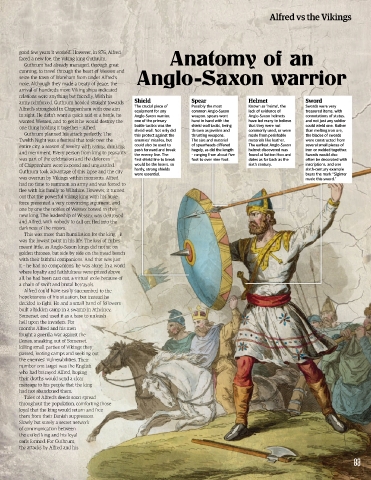
        faced a new foe, the Viking king Guthrum.            Anatomy of an
          Guthrum had already managed, through great
        cunning, to travel through the heart of Wessex and
        nose. Although they made a treaty of peace, the  Anglo-Saxon warrior
        seize the town of Wareham from under Alfred’s
        arrival of hundreds more Viking ships indicated
        relations were anything but friendly. With his
        army reinforced, Guthrum headed straight towards   Shield   Spear               Helmet              Sword
        Alfred’s stronghold in Chippenham with one aim   The crucial piece of   Possibly the most   Known as ‘helms’, the   Swords were very
                                                equipment for any   common Anglo-Saxon   lack of evidence of   treasured items, with
        in sight. He didn’t want a quick raid or a battle, he   Anglo-Saxon warrior,   weapon, spears went   Anglo-Saxon helmets   connotations of status,
        wanted Wessex, and to get it he would destroy the   one of the primary   hand in hand with the   have led many to believe   and not just any soldier
        one thing holding it together – Alfred.   battle tactics was the   shield-wall tactic, being   that they were not   could wield one. Rather
                                                shield-wall. Not only did   thrown as javelins and   commonly used, or were   than melting iron ore,
          Guthrum planned his attack perfectly. The   this protect against the   thrusting weapons.   made from perishable   the blades of swords
        Twelth Night was a festival that took over the  enemies’ missiles, but   The size and material   materials like leather.   were constructed from
        entire city, a season of revelry        could also be used to   of spearheads differed   The earliest Anglo-Saxon   several small pieces of
                                                push forward and break   hugely, as did the length   helmet discovered was   iron or welded together.
        and merriment. Every person             the enemy line. The   – ranging from about five   found at Sutton Hoo and   Swords would also
        was part of the celebration a           first shield line to break   foot to over nine foot.   dates as far back as the   often be decorated with
        of Chippenham were expose               would be the losers, so                 sixth century.      inscriptions, and one
                                                hardy, strong shields                                       sixth-century example
        Guthrum took advantage of               were essential.                                             bears the mark “Sigimer
        was overrun by Vikings with                                                                         made this sword.”
        had no time to summon an a
        flee with his family to Wiltsh
        out that the powerful Viking
        force presented a very convin
        one by one the nobles of We
        new king. The leadership of W
        and Alfred, with nobody to c
        darkness of the moors.
          This was more than humi
        was the lowest point in his li
        meant little, as Anglo-Saxon
        golden thrones, but side by s
        with their faithful companio
        it – he had no companions, h
        where loyalty and faithfulne
        all, he had been cast out, a v
        a chain of swift and brutal b
          Alfred could have easily su
        hopelessness of his situation
        decided to fight. He and a sm
        built a hidden camp in a swa
        Somerset, and used it as a ba
        hell upon the invaders. For
        months Alfred and his men
        fought a guerilla war against
        Danes, sneaking out of Some
        killing small parties of Viking
        passed, looting camps and se
        the enemies’ vulnerabilities.
        number one target was the E
        who had betrayed Alfred, ho
        their deaths would send a cle
        message to his people that th
        had not abandoned them.
          Tales of Alfred’s deeds soo
        throughout the population, c
        loyal that the king would ret
        them from their Danish supp
        Slowly but surely a secret ne
        of communication between
        the exiled king and his loyal
        earls formed. For Guthrum,
        the attacks by Alfred and his
                                                                                                                             83

