


Page 86 - All About History - Issue 27-15
P. 86
REVIEWS


                         All About History on the books, TV shows and

                                filmscausingastirinthehistoryworld


        LADY CONSTANCE LYTTON:


        ARISTOCRAT, SUFFRAGETTE, MARTYR


        Wethinkweknowthesuffragettes
        Author Lyndsey Jenkins Publisher Biteback Publishing Price £20 Released Out now
           ady Constance Lytton is no Emmeline  the discrepancy between the classes in terms of  rightsfrequentlyfallintothetrapofglorifyingthe
           Pankhurst or Susan B Anthony; her story is  their treatment of women.       men and women involved with the movement,
           one that is not often told. It is that of one of   Reassuringly, Lady Constance Lytton is presented   placing them on the pedestals they were denied
           the several women and men following the   as a complete human being, flaws and all. This is   in the press at the time. Here, Lady Constance’s
       Lmore charismatic leaders. Lady Constance’s   not a greatest hits compilation of the suffragette’s   motives, weaknesses and martyrdom are not
        life itself, slotting easily into a wider picture of   deeds – though there are several outlined in detail,   revelled in, but carefully examined and dissected.
        more recognisable players, highlights the social   and the book itself does revolve around that pivotal   Easy as it is for biographers to fall into the trap of
        differences between a well-to-do woman becoming   moment of her time spent in prison as Jane – but   wanting to glorify the individual they feel they
        involved with the suffragette movement and the   instead a presentation of a human being. Jenkins   have gotten to know well, Lady Constance Lytton
        group of working class women involved. And   is a candid, honest story-teller, and therefore the   is humanised, her shyness, awkwardness, and
        this was exactly what Lady Constance wanted to   narrative is utterly engaging.  reluctance to engage with the majority of people
        highlight herself as she briefly adopted the persona   There are intermittent sour notes to Lady   detailed in full. The occasional foray into the
         f  ki   l  ‘J  W t  ’ t  t  l fi ht f  Constance’s life story, such as details of her   absurd – becoming agitated that the only topic
                                                 curring depression and involvement with   of conversation she could come up with was jam
                                                harlatan Homer Lane, but then that, again, is   when speaking to Lord Salisbury, for example – is
                                                 freshingly honest. Texts that deal with women’s   utterly human, and therefore considerably more
                                                                                       fascinating than another well-meaningly biased
                                                                                       character analysis of those involved with the
                                                                                       suffragette movement.
                                                                                         The media reports at the time describe a gaggle
                                                                                       of silly women, when in reality the suffragettes
                                                                                       were a calculating political group managing both
                                                                                       the cause and the image of their cause in a deeply
                                                                                       serious manner. In times when riots and violence,
                                                                                       sometimes co-ordinated, sometimes spontaneous,
                                                                                       over civil rights and human liberty were
                                                                                       commonplace, there are a surprising amount of
                                                                                       parallels that can be drawn to the continued fight
                                                                                       for equality between all people that is still playing
                                                                                       out around the world today.
                                                                                         With its candid, honest nature (and gloriously
                                                                                       rich foot-notes), this biography isn’t just for
                                                                                       those already interested in feminism and/or the
                                                                                       suffragette movement, but also in the changing
                                                                                       socioeconomic times of the turn of the transition
                                                                                       from one century to another, how a civil rights
                                                                                       movement gains momentum. Above all, it is a
                                                                                       fascinating study of a handful of the potential
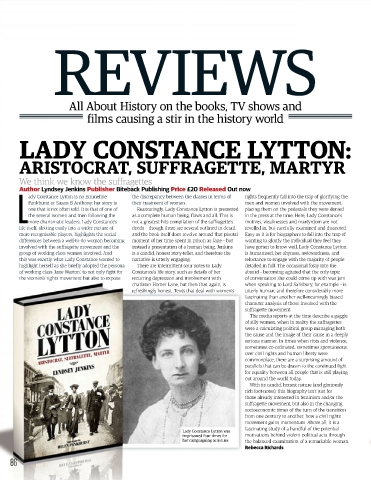
                                                                 Lady Constance Lytton was
                                                                 imprisoned four times for   motivations behind violent political acts through
                                                                 her campaigning activities  the balanced examination of a remarkable woman.
                                                                                       Rebecca Richards

