


Page 30 - World of Animals - Issue #29
P. 30
50 fabulous frogs


            2. Some frogs have eyes                                                           3. Purple frogs spend
                                                                                              95 per cent of the
            bigger than their bellies                                                         year underground


                                                                                              Also known as the pignose frog owing to its
                                                                                              unusually tapered snout, Nasikabatrachus
            Anyone that’s played Pac-Man will immediately   sometimes their voracious appetite can prove
            know why South American horned frogs   their downfall; if they try to chow down on   sahyadrensis is only found in a handful of sites
            are associated with the 1980s ghost guzzler.   something bigger than them, there’s a good   around the Western Ghats in southern India.
            When it’s feeling peckish (which is most of the   chance they will choke to death.  For a long time, the endangered species went
            time), there’s not much this creature won’t try   As territorial as it is greedy, even humans are   undetected because it leads a largely subterranean
            to eat. Lizards, fish, mice, insects and smaller   not safe from this fearless frog. There are tribes   life feasting on termites. It can seek out these

            frogs are all on the menu. Not to mention   in the Amazon who wear special high boots just   tasty treats with its sensitive snout and then suck
            each other, if the mood takes them. However,   to avoid falling victim to its mighty mouth!  them up with its tongue. The only time it ventures
                                                                                              out of its 3.5-metre (11.5-foot) deep burrow is to
                                                                                              reproduce for a few weeks around May.


            “As territorial as it is greedy, even humans
            are not safe from this fearless frog”


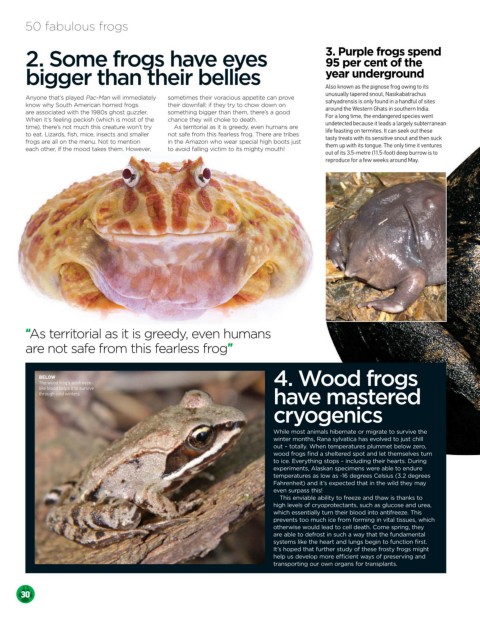
                BELOW                                                          4. Wood frogs
                The wood frog’s antifreeze-
                like blood helps it to survive
                through cold winters                                           have mastered
                                                                               cryogenics


                                                                               While most animals hibernate or migrate to survive the
                                                                               winter months, Rana sylvatica has evolved to just chill
                                                                               out – totally. When temperatures plummet below zero,

                                                                               wood frogs find a sheltered spot and let themselves turn
                                                                               to ice. Everything stops – including their hearts. During
                                                                               experiments, Alaskan specimens were able to endure
                                                                               temperatures as low as -16 degrees Celsius (3.2 degrees
                                                                               Fahrenheit) and it’s expected that in the wild they may
                                                                               even surpass this!
                                                                                 This enviable ability to freeze and thaw is thanks to
                                                                               high levels of cryoprotectants, such as glucose and urea,
                                                                               which essentially turn their blood into antifreeze. This
                                                                               prevents too much ice from forming in vital tissues, which
                                                                               otherwise would lead to cell death. Come spring, they
                                                                               are able to defrost in such a way that the fundamental
                                                                               systems like the heart and lungs begin to function first.

                                                                               It’s hoped that further study of these frosty frogs might

                                                                               help us develop more efficient ways of preserving and
                                                                               transporting our own organs for transplants.

           30

