


Page 35 - World of Animals - Issue #29
P. 35
50 fabulous frogs
35. Red-eyed tree frogs RED-EYED TREE FROG
use colour to survive Agalychnis callidryas
Class Amphibia
If you ran across this vibrant amphibian while trekking
through the humid Central American rainforest, you’d be Territory Central America
Diet Moths, flies, crickets
forgiven for stopping in your tracks, thinking you’d run Lifespan 5-6 years
across a poison dart frog. That’s exactly what the red-eyed Adult weight 6-14g (0.2-
tree frog wants you to think. In fact, it’s barely more toxic 0.5oz)
Conservation Status
than your common garden frog.
This creature has also learnt that there are times where
less colour can be equally effective. During the day, when LEAST CONCERN
it sleeps, these frogs curl up into a tight ball on the bottom
of a leaf, ensuring all of their limbs and body markings are
tucked out of sight. That way, as soon as they close their
eyes, all that remains visible is just another shade of green
in a green world.
Should their camouflage be rumbled, it’s time for
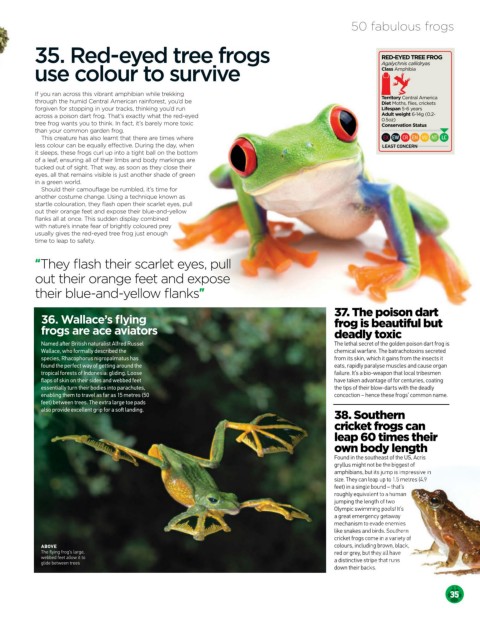
another costume change. Using a technique known as
startle colouration, they flash open their scarlet eyes, pull
out their orange feet and expose their blue-and-yellow
flanks all at once. This sudden display combined
with nature’s innate fear of brightly coloured prey
usually gives the red-eyed tree frog just enough
time to leap to safety.
“They fl ash their scarlet eyes, pull
out their orange feet and expose
their blue-and-yellow flanks”
37. The poison dart
36. Wallace’s flying frog is beautiful but
frogs are ace aviators deadly toxic
Named a er British naturalist Alfred Russel The lethal secret of the golden poison dart frog is
Wallace, who formally described the chemical warfare. The batrachotoxins secreted
species, Rhacophorus nigropalmatus has from its skin, which it gains from the insects it
found the perfect way of getting around the eats, rapidly paralyse muscles and cause organ
tropical forests of Indonesia: gliding. Loose failure. It’s a bio-weapon that local tribesmen
flaps of skin on their sides and webbed feet have taken advantage of for centuries, coating
essentially turn their bodies into parachutes, the tips of their blow-darts with the deadly
enabling them to travel as far as 15 metres (50 concoction – hence these frogs’ common name.
feet) between trees. The extra large toe pads
also provide excellent grip for a so landing.
38. Southern
cricket frogs can
leap 60 times their
own body length
Found in the southeast of the US, Acris
e
l
t b
o
u
h
y
t o
r
t n
e t
l
g
i
g
s m
s
g
gryllus might not be the biggest of f
i
h
e b
g
i
a
b
p
n
h
s
, b
u
p
i
m
m
u
i
v
p i
s i
n
e i
a
amphibians, but its jump is impressive in
s
t i
s j
t
m
e
s
r
e
a
5 m
e
y c
n l
p t
a
.
p u
o 1
e
r
z
s
e
e
s (
. T
size. They can leap up to 1.5 metres (4.9
h
.
9
i
t
4
l
s
o
’
u
e
e
n
e b
h
n
t
i
a
n a s
f feet) in a single bound – that’s
) i
d – t
g
t
o
m
o a h
a
roughly equivalent to a human
r
u
t t
h
n
u
a
u
i
v
g
l
l
y e
n
e
q
p
g t
j jumping the length of two
w
e l
h
n
i
o
n
t
e
u
g
h o
m
f t
Olympic swimming pools! It’s
O l y m p i c s w i m m i n g p o o l s ! I t ’ s
a g r e a t e m e r g e n c y g e t a w a y
a great emergency getaway
m e c h a n i s m t o e v a d e e n e m i e s
mechanism to evade enemies
h
r
e
n
a
n
k
s a
e
l
like snakes and birds. Southern
i
e s
k
. S
s
o
u
t
n
d b
i
d
r
cricket frogs come in a variety of
cricket frogs come in a variety of
colours, including brown, black,
ABOVE colours, including brown, black,
The flying frog’s large, red or grey, but they all have
red or grey, but they all have
webbed feet allow it to
a distinctive stripe that runs
glide between trees a distinctive stripe that runs
down their backs.
down their backs.
35

