


Page 81 - World of Animals - Issue #29
P. 81
Bizarre!


               The most colourful miniature                                                               DENISE’S PYGMY
                                                                                                          SEAHORSE
                                                                                                          Hippocampus denise
               seahorse is as strange                                                                     Class Actinopterygii

               as it is small                                                                             Territory Coral reefs in Asia
                                                                                                          and the Pacific

                                                                                                          Diet Zooplankton
                                                                                                          Lifespan Unknown
              As bright as their surroundings and                                                         Adult weight Unknown
              expertly hidden, these amazing                                                              Conservation status
              creatures were only recently discovered
                                                                                                          DATA DEFICIENT

              The males
              give birth


              Like most seahorses, it is the males
              that undergo pregnancy and give
              birth, but the female Denise’s
              pygmy seahorse deposits hundreds
              of eggs into the male’s trunk
              (instead of in their tail, as with
              other seahorses). Once safely
              inside dad’s body, the eggs are
              developed, and the male’s
              stomach swells until they are
              ready to be born.

              A fish that

              can’t swim


               Because of their small size, they
               actually can’t swim very well and rely
               on their prehensile tails to stay rooted
               to the coral they spend their lives
               in. They do have a swim bladder and
              gills like other fish, but the relentless

              currents of the strong oceans are just
               too much for these miniature seahorses,
               and staying anchored helps to avoid
               any Finding Nemo-type situations.

              Freaky feeders

              They feed very frequently as they don’t have
              a digestive system, and therefore nowhere to
              store food. They must eat continuously to get
              an adequate supply of nutrients. With no jaws,
              they use their snouts like straws, sucking food
              into their mouths.
              Masters of                             One of Earth’s                        No two seahorses
              camoufl age                             smallest seahorses  look the same


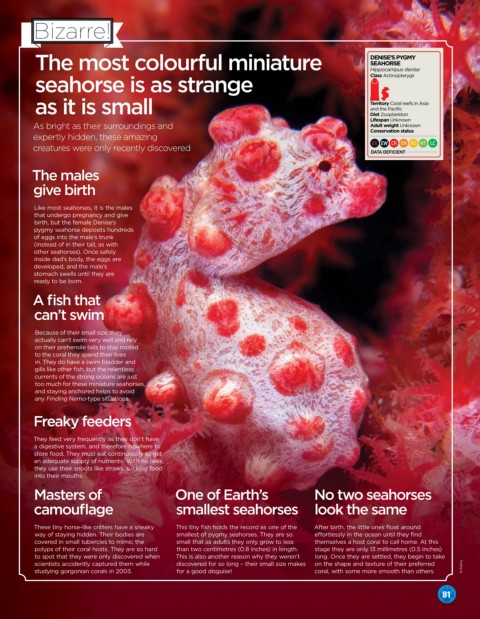
              These tiny horse-like critters have a sneaky   This tiny fish holds the record as one of the   After birth, the little ones float around

              way of staying hidden. Their bodies are   smallest of pygmy seahorses. They are so   effortlessly in the ocean until they find

              covered in small tubercles to mimic the   small that as adults they only grow to less   themselves a host coral to call home. At this
              polyps of their coral hosts. They are so hard   than two centimetres (0.8 inches) in length.   stage they are only 13 millimetres (0.5 inches)
               to spot that they were only discovered when   This is also another reason why they weren’t   long. Once they are settled, they begin to take
              scientists accidently captured them while   discovered for so long – their small size makes   on the shape and texture of their preferred   © Alamy
              studying gorgonian corals in 2003.     for a good disguise!                  coral, with some more smooth than others.
                                                                                                                             81

