


Page 77 - World of Animals - Issue #29
P. 77
CONSERVING


                               THE PANGOLIN


                                                       These scaly, solitary,
                                                secretive animals have found

                                                    themselves unfortunate
                                                 victims of wildlife trade and

                                                    are now one of the most
                                                  trafficked animals on Earth


                                                              Words Naomi Harding

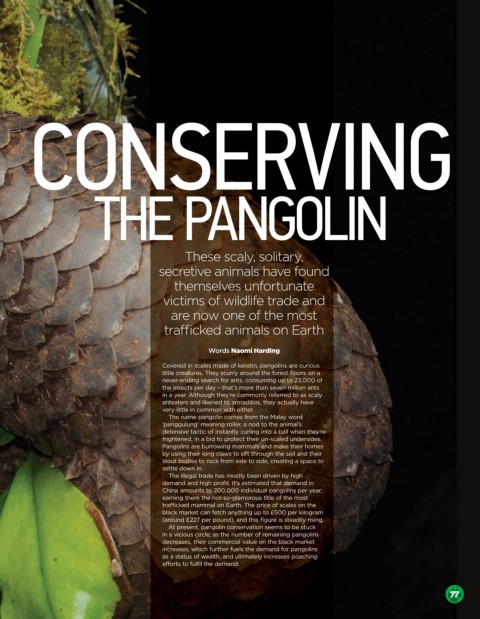
                                                 Covered in scales made of keratin, pangolins are curious
                                                 little creatures. They scurry around the forest floors on a

                                                 never-ending search for ants, consuming up to 23,000 of
                                                 the insects per day – that’s more than seven million ants
                                                 in a year. Although they’re commonly referred to as scaly
                                                 anteaters and likened to armadillos, they actually have
                                                 very little in common with either.
                                                   The name pangolin comes from the Malay word
                                                 ‘penggulung’ meaning roller, a nod to the animal’s
                                                 defensive tactic of instantly curling into a ball when they’re
                                                 frightened, in a bid to protect their un-scaled undersides.
                                                 Pangolins are burrowing mammals and make their homes
                                                 by using their long claws to sift through the soil and their
                                                 stout bodies to rock from side to side, creating a space to
                                                 settle down in.
                                                   The illegal trade has mostly been driven by high
                                                 demand and high profit. It’s estimated that demand in

                                                 China amounts to 200,000 individual pangolins per year,
                                                 earning them the not-so-glamorous title of the most

                                                 trafficked mammal on Earth. The price of scales on the
                                                 black market can fetch anything up to £500 per kilogram

                                                 (around £227 per pound), and this figure is steadily rising.
                                                   At present, pangolin conservation seems to be stuck
                                                 in a vicious circle; as the number of remaining pangolins
                                                 decreases, their commercial value on the black market
                                                 increases, which further fuels the demand for pangolins
                                                 as a status of wealth, and ultimately increases poaching
                                                 efforts to fulfil the demand.


                                                                                                                               77

