


Page 84 - BBC Music (January 2020)
P. 84
Chamber
CHAMBER CHOICE Julian Anderson
Poetry Nearing Silence; Van
Weinberg wins the heart Gogh Blue; Ring Dance;
Bearded Lady; Prayer;
Another Prayer; The Colour
with emotional poetry of Pomegranates
Nash Ensemble/Martyn Brabbins
NMC NMCD256 78:06 mins
The programming of these post-war works paints This scintillating
collection of
an affecting picture of the composer, says Erik Levi chamber works is
aptly titled after
Julian Anderson’s
eight-movement
suite, Poetry Nearing Silence –
while its cover depicts a telling
art-cum-poetry fragment from the
Tom Phillips book that inspired it.
‘Unpack/ delight/ savour/ the old/
adventure’: in effect, these words
– and the erased words or ‘silence’
part-visible around them – embody
what Anderson does in music
through seven, strikingly cogent
pieces dating from 1987 to 2015.
Stylistically impossible to
pigeonhole, each vividly evokes its
extra-musical foundations while
springing from Anderson’s urge to
explore the stuff of music. Form and
expression, colour and character
become adventures in sound and
association while at the same time
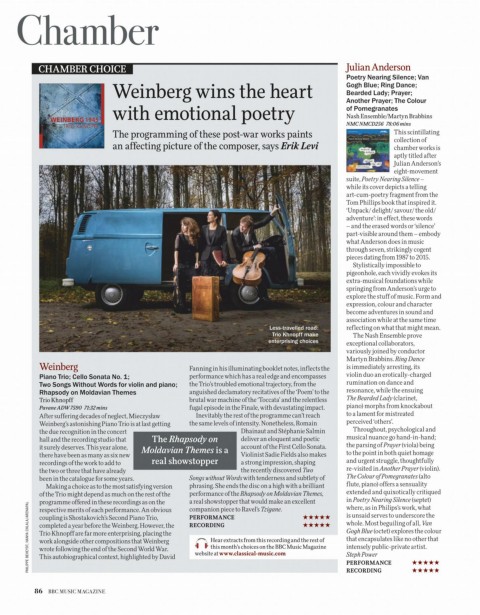
Less-travelled road: reflecting on what that might mean.
Trio Khnopff make The Nash Ensemble prove
enterprising choices exceptional collaborators,
variously joined by conductor
Martyn Brabbins. Ring Dance
Weinberg Fanning in his illuminating booklet notes, inflects the is immediately arresting, its
Piano Trio; Cello Sonata No. 1; performance which has a real edge and encompasses violin duo an erotically-charged
Two Songs Without Words for violin and piano; the Trio’s troubled emotional trajectory, from the rumination on dance and
Rhapsody on Moldavian Themes anguished declamatory recitatives of the ‘Poem’ to the resonance, while the ensuing
Trio Khnopff brutal war machine of the ‘Toccata’ and the relentless The Bearded Lady (clarinet,
Pavane ADW 7590 71:32 mins fugal episode in the Finale, with devastating impact. piano) morphs from knockabout
After suffering decades of neglect, Mieczys!aw Inevitably the rest of the programme can’t reach to a lament for mistreated
Weinberg’s astonishing Piano Trio is at last getting the same levels of intensity. Nonetheless, Romain perceived ‘others’.
the due recognition in the concert Dhainaut and Stéphanie Salmin Throughout, psychological and
hall and the recording studio that The Rhapsody on deliver an eloquent and poetic musical nuance go hand-in-hand;
it surely deserves. This year alone, Moldavian Themes is a account of the First Cello Sonata. the parsing of Prayer (viola) being
there have been as many as six new Violinist Sadie Fields also makes to the point in both quiet homage
recordings of the work to add to real showstopper a strong impression, shaping and urgent struggle, thoughtfully
the two or three that have already the recently discovered Two re-visited in Another Prayer (violin).
been in the catalogue for some years. Songs without Words with tenderness and subtlety of The Colour of Pomegranates (alto
Making a choice as to the most satisfying version phrasing. She ends the disc on a high with a brilliant flute, piano) offers a sensuality
of the Trio might depend as much on the rest of the performance of the Rhapsody on Moldavian Themes, extended and quixotically critiqued
in Poetry Nearing Silence (septet)
a real showstopper that would make an excellent
programme offered in these recordings as on the
PHILIPPE BEHEYDT, HANYA CHLALA/ARENAPAL coupling is Shostakovich’s Second Piano Trio, PERFORMANCE HHHHH whole. Most beguiling of all, Van
where, as in Philips’s work, what
companion piece to Ravel’s Tzigane.
respective merits of each performance. An obvious
is unsaid serves to underscore the
HHHHH
completed a year before the Weinberg. However, the
RECORDING
Gogh Blue (octet) explores the colour
Trio Khnopff are far more enterprising, placing the
that encapsulates like no other that
Hear extracts from this recording and the rest of
work alongside other compositions that Weinberg
this month’s choices on the BBC Music Magazine
intensely public-private artist.
wrote following the end of the Second World War.
website at www.classical-music.com
Steph Power
This autobiographical context, highlighted by David
HHHHH
PERFORMANCE
86 BBC MUSIC MAGAZINE RECORDING HHHHH

