


Page 24 - Jetpower (January 2020)
P. 24
022-025 Odyssey:Layout 1 Englisch  09.01.2020  13:43 Uhr  Seite 24


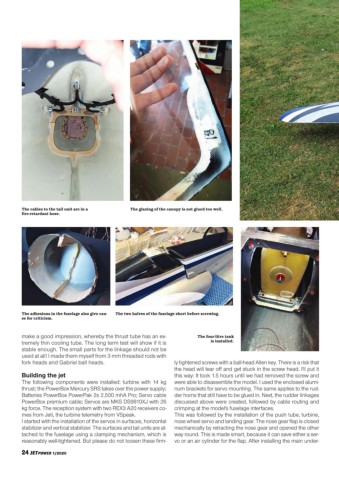
              The cables to the tail unit are in a   The glazing of the canopy is not glued too well.
              fire-retardant hose.


              The adhesions in the fuselage also give cau-  The two halves of the fuselage short before screwing.
              se for criticism.


              make a good impression, whereby the thrust tube has an ex-    The four-litre tank
              tremely thin cooling tube. The long term test will show if it is   is installed.
              stable enough. The small parts for the linkage should not be
              used at all! I made them myself from 3 mm threaded rods with
              fork heads and Gabriel ball heads.                    ly tightened screws with a ball-head Allen key. There is a risk that
                                                                    the head will tear off and get stuck in the screw head. I'll put it
              Building the jet                                      this way: It took 1.5 hours until we had removed the screw and
              The following components were installed: turbine with 14 kg  were able to disassemble the model. I used the enclosed alumi-
              thrust; the PowerBox Mercury SRS takes over the power supply;  num brackets for servo mounting. The same applies to the rud-
              Batteries PowerBox PowerPak 2s 2,500 mhA Pro; Servo cable  der horns that still have to be glued in. Next, the rudder linkages
              PowerBox premium cable; Servos are MKS DS9910XJ with 26  discussed above were created, followed by cable routing and
              kg force. The reception system with two REX3 A20 receivers co-  crimping at the model's fuselage interfaces.
              mes from Jeti, the turbine telemetry from VSpeak.     This was followed by the installation of the push tube, turbine,
              I started with the installation of the servos in surfaces, horizontal  nose wheel servo and landing gear. The nose gear flap is closed
              stabilizer and vertical stabilizer. The surfaces and tail units are at-  mechanically by retracting the nose gear and opened the other
              tached to the fuselage using a clamping mechanism, which is  way round. This is made smart, because it can save either a ser-
              reasonably well-tightened. But please do not loosen these firm-  vo or an air cylinder for the flap. After installing the main under-

              24 JETPOWER 1/2020

