


Page 50 - (DK Eyewitness) Travel Guide - Sydney
P. 50
48 INTRODUCING SY DNEY
Exploring the Parks and Reserves
Despite 200 years of European settlement, Sydney’s parks
and reserves contain a surprising variety of native wildlife.
Approximately 2,000 species of native plants, 1,000 cultivated
and weed species and 300 bird species have managed to
adapt favourably to the changes.
Several quite distinct vegetation types are protected in
the bushland around Sydney, and these in turn provide
shelter for a wide range of birds and animals. Even the more
formal parks such as Hyde Park and the Royal Botanic Garden
are home to many indigenous species, allowing the visitor
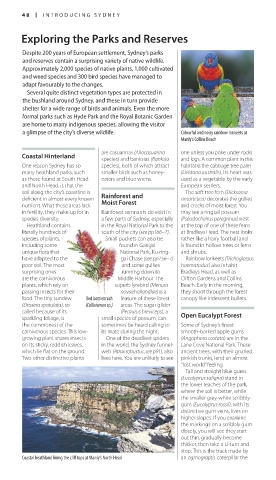
a glimpse of the city’s diverse wildlife. Colourful and noisy rainbow lorikeets at
Manly’s Collins Beach
are casuarinas (Allocasuarina one unless you poke under rocks
Coastal Hinterland species) and banksias (Banksia and logs. A common plant in this
One reason Sydney has so species), both of which attract habitat is the cabbage tree palm
many heathland parks, such smaller birds such as honey- (Livistona australis). Its heart was
as those found at South Head eaters and blue wrens. used as a vegetable by the early
and North Head, is that the European settlers.
soil along the city’s coastline is Rainforest and The soft tree fern (Dicksonia
deficient in almost every known antartctica) decorates the gu l lies
nutrient. What these areas lack Moist Forest and creeks of moist forest. You
in fertility, they make up for in Rainforest remnants do exist in may see a ringtail possum
species diversity. a few parts of Sydney, especially (Pseudocheirus peregrinus) nest
Heathland contains in the Royal National Park to the at the top of one of these ferns
literally hundreds of south of the city (see pp166–7). at Bradleys Head. The nest looks
species of plants, Small pockets can also be rather like a hairy football and
including some found in Garigal is found in hollow trees or ferns
unique flora that National Park, Ku-ring- and shrubs.
have adapted to the gai Chase (see pp156–7) Rainbow lorikeets (Trichoglossus
poor soil. The most and some gullies haematodus) also inhabit
surprising ones running down to Bradleys Head, as well as
are the carnivorous Middle Harbour. The Clifton Gardens and Collins
plants, which rely on superb lyrebird (Menura Beach. Early in the morning,
passing insects for their novaehol landiae) is a they shoot through the forest
food. The tiny sundew Red bottlebrush feature of these forest canopy like iridescent bullets.
(Drosera spa tulata), so (Callistemon sp.) areas. The sugar glider
called because of its (Petaurus breviceps), a Open Eucalypt Forest
sparkling foliage, is small species of possum, can
the commonest of the some times be heard calling to Some of Sydney’s finest
carnivorous species. This low- its mate during the night. smooth-barked apple gums
growing plant snares insects One of the deadliest spiders (Angophora costata) are in the
on its sticky, reddish leaves, in the world, the Sydney funnel- Lane Cove National Park. These
which lie flat on the ground. web (Atrax robustus, see p91), also ancient trees, with their gnarled
Two other distinctive plants lives here. You are unlikely to see pinkish trunks, lend an almost
“lost world” feeling.
Tall and straight blue gums
(Eucalyptus saligna) stand in
the lower reaches of the park,
where the soil is better, while
the smaller grey-white scrib bly
gum (Eucalyptus rossii), with its
distinctive gum veins, lives on
higher slopes. If you examine
the markings on a scribbly gum
closely, you will see they start
out thin, gradu ally become
thicker, then take a U-turn and
stop. This is the track made by
Coastal heathland lining the cliff tops at Manly’s North Head an ogmograptis caterpillar the
048-049_EW_Sydney.indd 48 29/05/17 12:15 pm

