


Page 51 - (DK Eyewitness) Travel Guide - Sydney
P. 51
SY DNEY A T A GLANCE 49
previous year. The grubs that plant or animal to live. There
made the track become small, is no fresh water and, unlike
brownish-grey moths and are soil, the mud has no oxygen
commonly seen in eucalypt or whatsoever below the very
gum forests. surface level. Mangroves have
Grass trees (Xanthorrhoea developed some fascinating
species), also common in open ways around these problems.
eucalypt forest, are an ancient First, excess salt is excreted
plant species with a tall spike from their leaves. Secondly,
that bears white flowers in they get oxygen to the roots by
spring. Lyrebirds, echidnas, pushing special peg-like roots,
currawongs and black snakes called pneumatophores, into
are predominant wildlife. the air. At low tide, these can be
clearly seen around the base of
most mangroves. They allow air
to diffuse down into the roots so
that they can sur vive the stifling
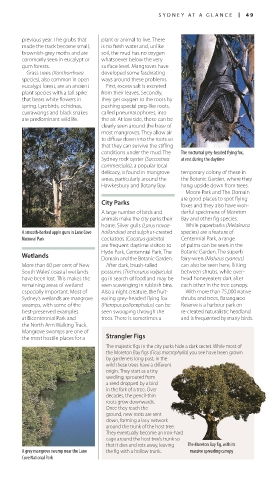
conditions under the mud. The The nocturnal grey-headed flying fox,
Sydney rock oyster (Saccostrea at rest during the daytime
com mercialis), a popular local
delicacy, is found in mangrove temporary colony of these in
areas, particularly around the the Botanic Gar den, where they
Hawkesbury and Botany Bay. hang upside down from trees.
Moore Park and The Domain
are good places to spot flying
City Parks
foxes and they also have won-
A large number of birds and derful specimens of Moreton
animals make the city parks their Bay and other fig species.
home. Silver gulls (Larus novae While paperbarks (Melaleuca
A smooth-barked apple gum in Lane Cove hollandiae) and sulphur-crested species) are a feature of
National Park cockatoos (Cacatua galerita) Cen tennial Park, a range
are frequent daytime visitors to of palms can be seen in the
Hyde Park, Centennial Park, The Botanic Garden. The superb
Wetlands
Domain and the Botanic Garden. fairy-wren (Malurus cyaneus)
More than 60 per cent of New After dark, brush-tailed can also be seen here, flitting
South Wales’ coastal wetlands possums (Trichosurus vulpecula) between shrubs, while over-
have been lost. This makes the go in search of food and may be head honeyeaters dart after
remaining areas of wetland seen scavenging in rubbish bins. each other in the tree canopy.
especially important. Most of Also a night creature, the fruit- With more than 75,000 native
Sydney’s wetlands are mangrove eating grey-headed flying fox shrubs and trees, Barangaroo
swamps, with some of the (Pteropus poliocephalus) can be Reserve is a harbour park on
best-preserved examples seen swoop ing through the re-created naturalistic headland
at Bicentennial Park and trees. There is sometimes a and is frequented by many birds.
the North Arm Walking Track.
Mangrove swamps are one of
the most hostile places for a Strangler Figs
The majestic figs in the city parks hide a dark secret. While most of
the Moreton Bay figs (Ficus macrophylla) you see have been grown
by gardeners long past, in the
wild these trees have a different
origin. They start as a tiny
seedling, sprouted from
a seed dropped by a bird
in the fork of a tree. Over
decades, the pencil-thin
roots grow downwards.
Once they reach the
ground, new roots are sent
down, forming a lacy network
around the trunk of the host tree.
They eventually become an iron-hard
cage around the host tree’s trunk so
that it dies and rots away, leaving The Moreton Bay fig, with its
A grey mangrove swamp near the Lane the fig with a hollow trunk. massive spreading canopy
Cove National Park
048-049_EW_Sydney.indd 49 29/05/17 12:15 pm

