


Page 77 - (DK Eyewitness) Travel Guide - Sydney
P. 77
THE ROCKS AND CIRCULAR QU A Y 75
a St Philip’s Church
3 York St (enter from Jamison St).
Map 1 A3. Tel 9247 1071.
@ 311. Open 9am–5pm Mon–Fri.
Closed 26 Jan. 8 5 8:30am,
10:15am (for children), 6pm Sun.
∑ churchhillanglican.com
Despite its elevated site, this
Victorian Gothic church seems
overshadowed in its modern
setting. Yet, when it was first
built, the tall square tower
with its decorative pin nacles
Façade of the Museum of Contemporary Art was a local landmark.
Begun in 1848, St Philip’s is
o Museum of picnic. The MCA Store sells by Edmund Blacket, dubbed
Contemporary Art distinctive gifts by Australian “the Christopher Wren of
designers, as well as books on Australia” for the 58 churches
Circular Quay West, The Rocks. Map 1 contemporary art and design. he designed. In 1851, work
B2. Tel 9245 2400. @ Sydney Explorer, was disrupted when its stone-
Circular Quay routes from Elizabeth St. masons left for the gold fields,
Circular Quay. Open 10am–5pm p National Trust but was completed by 1856.
daily (to 9pm Thu). Closed 25 Dec. Centre
7 8 ∑ mca.com.au A peal of bells was donated
Observatory Hill, Watson Rd, The Rocks. in 1858, with another added in
Sydney’s substantial collection Map 1 A3. Tel 9258 0123. @ Sydney 1888 to mark Sydney’s centen-
of contemporary art has grown Explorer, 311. Circular Quay, ary. These bells are still in use.
steadily, but largely out of public Wynyard. Open 9am–5pm Mon–Fri.
view, since 1943. This was the year Gallery: Open 11am–5pm Tue–Sun.
John Power died, leaving his art Closed public hols. - 7 =
collection and a financial bequest ∑ nationaltrust.org.au/places/
to the University of Sydney. national-trust-centre
In 1991, the permanent
collection, including works by The buildings that form the
Hockney, Warhol, Lichtenstein head quarters of the con servation
and Christo, was transferred organization, the National Trust
to this 1950s Art Deco-style of Australia (NSW), date from
former Maritime Services Board 1815, when Macquarie chose
Building. The museum also the site on Observatory Hill for
hosts tempo rary exhibitions a military hospital.
of works by both Australian Today they house the S H Ervin
and international artists. Gallery, with changing exhibitions
The grassed area at the throughout the year, designed
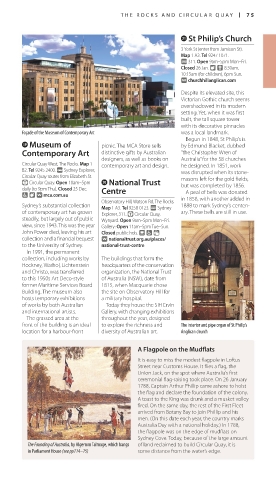
front of the building is an ideal to explore the richness and The interior and pipe organ of St Philip’s
location for a harbour-front diversity of Australian art. Anglican church
A Flagpole on the Mudflats
It is easy to miss the modest flagpole in Loftus
Street near Customs House. It flies a flag, the
Union Jack, on the spot where Australia’s first
ceremonial flag-raising took place. On 26 January
1788, Captain Arthur Phillip came ashore to hoist
the flag and declare the foun dation of the colony.
A toast to the King was drunk and a musket volley
fired. On the same day, the rest of the First Fleet
arrived from Botany Bay to join Phillip and his
men. (On this date each year, the country marks
Australia Day with a national holiday.) In 1788,
the flag pole was on the edge of mudflats on
Sydney Cove. Today, because of the large amount
The Founding of Australia, by Algernon Talmage, which hangs of land reclaimed to build Circular Quay, it is
in Parliament House (see pp114–15) some distance from the water’s edge.
074-075_EW_Sydney.indd 75 29/05/17 12:19 pm

