


Page 130 - How It Works - Book Of Amazing Answers To Curious Questions, Volume 05-15
P. 130
What’s                              the                science


         behind racing


         simulators?                                                            These high-tech simulators
                                                                                are almost as good as the
                                                                                real thing


                 e have all played on driving simulators   three planes to sense yaw, pitch and roll. As a   (26-foot) screen and have a projection and

                 in arcades or on games consoles at   person’s body is moved about, tiny hair cells in   resolution rate five times faster than that of a
         Whome, but what was once a bit of fun is   the vestibule and semi-circular canals stimulate   multiplex cinema, offering razor-sharp and,
          now a serious business – and a crucial part of a   the vestibular nerve, helping the brain to   crucially, time-accurate images of the circuit
          professional racing driver’s preparation for any   interpret nerve impulses resulting from these   that is being tested.
          major competition.                   six primary movements.                 This all means simulators are a great way to
           The science behind these sophisticated   This is where the genius of new driving   get much needed practice on a circuit ahead of a
          modern-day race simulators lies within the   simulators come in: the movements of the   race – particularly if it’s a track that the driver
          human vestibular system, which comprises the   simulator are designed to arouse a driver’s   has never visited before – and all done in
          small canals and bones in the inner ear. The   vestibular nerves, creating a driving experience   familiar surroundings despite never actually
          utricle and saccule organs in the vestibular   that’s more true-to-life.  As well as a real and   sitting in a car. The accuracy of the facility means
          system help humans detect linear acceleration   working dashboard, the simulator is fi tted with   that time spent in the simulator is very nearly as
          in three directions: vertical (for example,   pedals that are hydraulically weighted the same   good as doing the time in the cockpit itself,
          gravity), lateral (sway), and longitudinal (surges   as the car they’re testing, and it’s the same for   ensuring that the driver can enter a race buoyed
          forward or backwards). In addition, three   the power steering ‘feel’ too. As for the graphics,   by as much experience behind the wheel
          fl uid-filled semi-circular canals are oriented in   they are displayed on a huge eight-metre   as possible.


           The lifestyle of a
           pro racing driver

           You may think there’s little else to the job of a
           professional racing driver than simply pulling up
           to the starting line and completing numerous laps
           of a circuit, but as Porsche’s World Endurance
           Championship driver Nick Tandy tells us, you have
           to be ‘race fit’ to be able to pilot a modern race car.

            With cars even more powerful and capable of
           pulling high g-forces through every twist and turn
           of a race, the driver needs to be mentally and

           physically fit enough to handle these constraints on
           the body, particularly in an endurance race such as
           the Le Mans 24 Hours.
            As such, pro drivers have intense fi tness regimes
           and strict diet plans, with performance training to
           help improve reaction times and their
           acclimatisation to extreme heat. It doesn’t end
           there, either: tactics are an important part of
           professional racing and drivers work hard to be
           attuned to the best setups of their car and driving
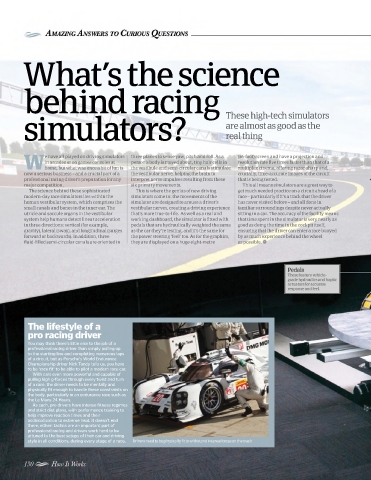
           style in all conditions, during every stage of a race.  Drivers need to be physically fit to withstand intense forces on the track


          130        How It W orks
          130
                    How It Works

