


Page 132 - How It Works - Book Of Amazing Answers To Curious Questions, Volume 05-15
P. 132
How do aircraft toilets


         work?                           The powerful vacuum system that fl               ushes

                                         your waste at 30,000 feet


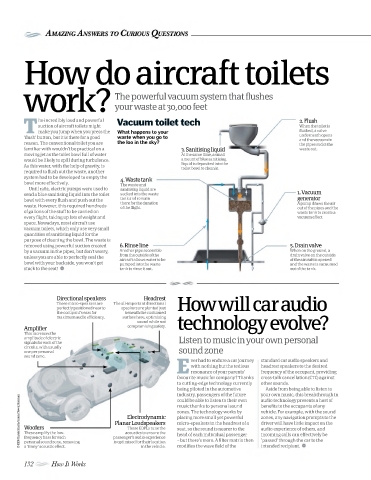
              he incredibly loud and powerful   Vacuum toilet tech                                        2. Flush
              suction of aircraft toilets might                                                           When the toilet is

         Tmake you jump when you press the   What happens to your                                         flushed, a valve
                                                                                                          underneath opens
         ‘flush’ button, but it is there for a good   waste when you go to                                 and the vacuum in

         reason. The conventional toilet you are   the loo in the sky?                                    the pipes sucks the
         familiar with wouldn’t be practical on a                3. Sanitising liquid                     waste out.
         moving jet as the toilet bowl full of water             At the same time, a small
         would be likely to spill during turbulence.             amount of blue sanitising
                                                                 liquid is deposited into the
         As this water, with the help of gravity, is             toilet bowl to clean it.
         required to flush out the waste, another

         system had to be developed to empty the   4. Waste tank
         bowl more effectively.            The waste and
           Until 1982, electric pumps were used to   sanitising liquid are
         send a blue sanitising liquid into the toilet   sucked into the waste                            1. Vacuum
         bowl with every flush and push out the   tank and remain                                          generator

                                                                                                          A pump draws the air
                                           there for the duration
         waste. However, this required hundreds   of the fl ight.                                          out of the pipes and the
         of gallons of the stuff to be carried on                                                         waste tank to create a
         every flight, taking up lots of weight and                                                        vacuum effect.

         space. Nowadays, most aircraft use
         vacuum toilets, which only use very small
         quantities of sanitising liquid for the
         purpose of cleaning the bowl. The waste is
         removed using powerful suction created   6. Rinse line                                        5. Drain valve
         by a vacuum in the pipes, but don’t worry,   Another pipe accessible                          When on the ground, a
         unless you are able to perfectly seal the   from the outside of the                           drain valve on the outside
                                           aircraft allows water to be
                                                                                                       of the aircraft is opened
         bowl with your backside, you won’t get   pumped into the waste                                and the waste is vacuumed
         stuck to the seat!                tank to rinse it out.                                       out of the tank.
                     Directional speakers           Headrest
                     These micro-speakers are   The all-important directional   How will car audio
                     perfectly positioned near to   speakers are planted just
                     the occupant’s ears for   beneath the cushioned
                     maximum audio effi ciency.  surface here, optimising
                                                 sound while not   technology evolve?
          Amplifier                           compromising safety.
          This increases the
          amplitude of electric                                 Listen to music in your own personal
          signals for each of the
          circuits, with usually
          one per personal                                      sound zone
          sound zone.
                                                                    ver had to endure a car journey   standard car audio speakers and
                                                                    with nothing but the tedious   headrest speakers to the desired
                                                               Eresonance of your parents’   frequency of the occupant, providing
                                                               favourite music for company? Thanks   cross-talk cancellation (CTC) against
                                                               to cutting-edge technology currently   other sounds.
                                                                                              Aside from being able to listen to
                                                               being piloted in the automotive   your own music, this breakthrough in
                                                               industry, passengers of the future
        © REX/Darek Siusta/Solent News; Harman  Woofers   passenger’s audio experience   music thanks to personal sound   benefits to the occupants of any
                                                                                             audio technology presents a host of
                                                               could be able to listen to their own

                                                                                             vehicle. For example, with the sound
                                                               zones. The technology works by
                                              Electrodynamic
                                                               placing more small yet powerful
                                                                                             zones, any navigation prompts to the
                                         Planar Loudspeakers
                                                                                             driver will have little impact on the
                                                               micro-speakers in the headrest of a
                                                               seat, so the sound is nearer to the
                                                                                             audio experience of others, and
                                              These EDPLs tune the
          These amplify the low-
                                             acoustics to ensure the
                                                                                             incoming calls can effectively be
                                                               head of each individual passenger
          frequency bass for each
                                                                                             ‘passed’ through the car to the

                                                               – but there’s more. A filter matrix then
                                         is optimised for their location
          personal sound zone, removing


          a ‘tinny’ acoustic effect.
          132       How It Works                   in the vehicle.  modifies the wave field of the   intended recipient.

