


Page 33 - How It Works - Book Of Amazing Answers To Curious Questions, Volume 05-15
P. 33
Environment


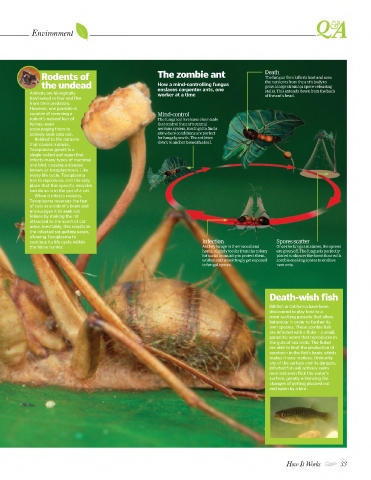
                Rodents of                              The zombie ant                        Death
                                                                                              The fungus then kills its host and uses
                the undead                              How a mind-controlling fungus         the nutrients from the ant’s body to
                                                                                              grow a large stroma (a spore-releasing
                                                        enslaves carpenter ants, one          stalk). This extends down from the back
           Animals are biologically                     worker at a time                      of the ant’s head.
           hard-wired to fear and fl ee
           from their predators.
           However, one parasite is
           capable of reversing a                       Mind-control
           rodent’s natural fear of                     The fungal cells release chemicals
           felines, even                                that control the ant’s central
           encouraging them to                          nervous system, forcing it to fi nd a
           actively seek cats out.                      site where conditions are perfect
             Related to the parasite                    for fungal growth. The ant bites
           that causes malaria,                         down to anchor beneath a leaf.
           Toxoplasma gondii is a
           single-celled pathogen that
           infects many types of mammal
           and bird, causing a disease
           known as toxoplasmosis. Like
           every life cycle, Toxoplasma
           has to reproduce, and the only
           place that this specifi c microbe
           can do so is in the gut of a cat.
             When it infects rodents,
           Toxoplasma reverses the fear
           of cats in a rodent’s brain and
           encourages it to seek out
           felines by making the rat
           attracted to the scent of cat
           urine. Inevitably, this results in
           the infected rat getting eaten,
           allowing Toxoplasma to
           continue its life cycle within                               Infection                 Spores scatter
           the feline hunter.                                           As they forage in their woodland   Once the fungus matures, the spores
                                                                        home, slightly too far from the colony   are given off. The fungus is perfectly
                                                                        for social immunity to protect them,   placed to shower the forest fl oor with
                                                                        worker ants unwittingly get exposed   zombie-making spores to enslave
                                                                        to fungal spores.         new ants.


                                                                                                Death-wish fi        sh


                                                                                                Killifish in California have been
                                                                                                discovered to play host to a
                                                                                                mind-sucking parasite that alters
                                                                                                behaviour in order to further its
                                                                                                own species. These zombie fi sh

                                                                                                are infected with a fluke – a small,
                                                                                                parastitic worm that reproduces in
                                                                                                the guts of sea birds. The fl ukes
                                                                                                are able to limit the production of

                                                                                                serotonin in the fish’s brain, which
                                                                                                makes it very restless. Ordinarily
                                                                                                shy of the surface and its dangers,

                                                                                                infected fish will actively swim

                                                                                                near and even flick the water’s
                                                                                                surface, greatly enhancing the
                                                                                                changes of getting plucked out
                                                                                                and eaten by a bird.
                                                                                                                              © Science Photo Library; Corbis; Thinkstock


                                                                                                      How It Works        33

