


Page 28 - How It Works - Book Of Amazing Answers To Curious Questions, Volume 05-15
P. 28
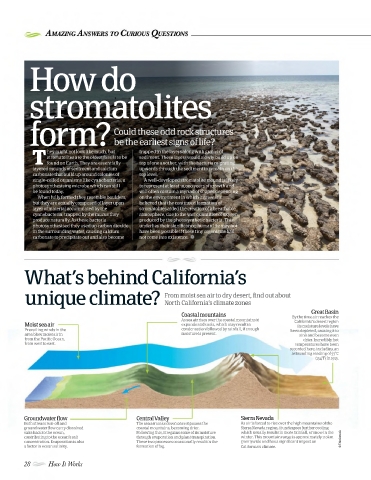
How                      do


           stromatolites


                                         Could these odd rock structures
           form? be the earliest signs of life?

                  hey might not look like much, but   trapped in the layers along with grains of
                  stromatolites are the oldest fossils to be   sediment. These layers would slowly build up on
            Tfound on Earth. They are essentially   top of one another, with the bacteria migrating
             layered mounds of sediment and calcium   upwards through the sediment to remain on the
             carbonate that build up around colonies of   top level.
             single-celled organisms like cyanobacteria, a   A well-developed stromatolite mound is likely
             photosynthesising microbe which can still   to represent at least 10,000 years of growth and
             be found today.                      will often contain a myriad of shapes depending
              When fully formed they resemble boulders,   on the environment in which it grew. It’s
             but they are actually composed of layer upon   believed that the continued formation of
             layer of material accumulated by the   stromatolites aided the creation of a breathable
             cyanobacteria, trapped by the mucus they   atmosphere, due to the vast quantities of oxygen
             produce naturally. As these bacteria   produced by the photosynthetic bacteria. This

             photosynthesised they used up carbon dioxide   underlies their significance; human life may not
             in the surrounding water, causing calcium   have been possible if these tiny organisms had
             carbonate to precipitate out and also become   not come into existence.


          What’s behind California’s


          unique climate?                                  From moist sea air to dry desert, find out about

                                                           North California’s climate zones
                                                                                                              Great Basin
                                                                 Coastal mountains                      By the time air reaches the
                                                                 As sea air rises over the coastal mountains it   California’s desert region
          Moist sea air                                          expands and cools, which may result in   its moisture levels have
          Prevailing winds in the                                condensation followed by rainfall, if enough   been depleted, causing it to
          area blow moist air in                                 moisture is present.                     sink and become even
          from the Pacifi c Ocean,                                                                           drier. Incredibly hot
          from west to east.                                                                             temperatures have been
                                                                                                       recorded here, including an
                                                                                                        astounding reading of 57°C
                                                                                                                (134°F) in 1913.


          Groundwater flow                       Central Valley                       Sierra Nevada
          Both stream run-off and                The sea air sinks down once it passes the   As air is forced to rise over the high mountains of the
          groundwater flow carry dissolved        coastal mountains, becoming drier.   Sierra Nevada region, it undergoes further cooling

          salts back to the ocean,               Following this, it regains some of its moisture   which usually results in more rainfall, or snow in the
          contributing to the ocean’s salt       through evaporation and plant transpiration.   winter. This mountain range is approximately 110km   © Thinkstock
          concentration. Evaporation is also     These two processes occasionally result in the   (70mi) wide and has a significant impact on

          a factor in ocean salinity.            formation of fog.                    California’s climate.
          28       How It Works

