


Page 102 - (DK Eyewitness) Travel Guide 2016 - Austria
P. 102
100 VIENNA AREA B Y AREA
Michelangelo, Raphael, Peter Paul
Rubens, Leonardo da Vinci, Diego
Velázquez and Titian, symbolizing
the timeless value of art.
Today, the Künstlerhaus
still serves as an exhibition
space, focusing on architecture,
interdisciplinary themes and
international cooperation.
There is also a space for live
performances, a cinema,
theatre and restaurant.
q Musikverein
Bösendorferstrasse 12. Map 5 D1.
Tel 50 58 190. % Karlsplatz. v 1, 2,
62, 71, D. @ 2A, 4A, 59A. Open
guided tours: please phone for details;
box office: 9am–8pm Mon–Fri, 9am–
1pm Sat and 1hr before concerts.
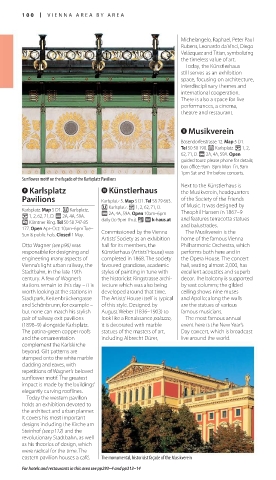
Sunflower motif on the façade of the Karlsplatz Pavilions
Next to the Künstlerhaus is
9 Karlsplatz 0 Künstlerhaus the Musikverein, headquarters
Pavilions Karlsplatz 5. Map 5 D1. Tel 58 79 663. of the Society of the Friends
% Karlsplatz. v 1, 2, 62, 71, D. of Music. It was designed by
Karlsplatz. Map 5 D1. % Karlsplatz. Theophil Hansen in 1867–9
v 1, 2, 62, 71, D. @ 2A, 4A, 59A. @ 2A, 4A, 59A. Open 10am–6pm
B Kärntner Ring. Tel 50 58 74785 daily (to 9pm Thu). & ∑ k-haus.at and features terracotta statues
177. Open Apr–Oct: 10am–6pm Tue– and balustrades.
Sun & public hols. Closed 1 May. Commissioned by the Vienna The Musikverein is the
Artists’ Society as an exhibition home of the famous Vienna
Otto Wagner (see p96) was hall for its members, the Philharmonic Orchestra, which
responsible for designing and Künstlerhaus (Artists’ House) was performs both here and in
engineering many aspects of completed in 1868. The society the Opera House. The concert
Vienna’s light urban railway, the favou red grandiose, academic hall, seating almost 2,000, has
Stadtbahn, in the late 19th styles of painting in tune with excellent acoustics and superb
century. A few of Wagner’s the historicist Ringstrasse archi decor. The balcony is supported
stations remain to this day – it is tec ture which was also being by vast columns; the gilded
worth looking at the stations in deve loped around that time. ceiling shows nine muses
Stadtpark, Kettenbrückengasse The Artists’ House itself is typical and Apollo; along the walls
and Schönbrunn, for example – of this style. Designed by are the statues of various
but none can match his stylish August Weber (1836–1903) to famous musicians.
pair of railway exit pavilions look like a Renaissance palazzo, The most famous annual
(1898–9) along side Karlsplatz. it is decorated with marble event here is the New Year’s
The patinagreen copper roofs statues of the masters of art, Day concert, which is broadcast
and the ornamen tation including Albrecht Dürer, live around the world.
complement the Karlskirche
beyond. Gilt patterns are
stamped onto the white marble
cladding and eaves, with
repetitions of Wagner’s beloved
sunflower motif. The greatest
impact is made by the buildings’
elegantly curving rooflines.
Today the western pavilion
holds an exhibition devoted to
the architect and urban planner.
It covers his most important
designs including the Kirche am
Steinhof (see p112) and the
revolutionary Stadtbahn, as well
as his theories of design, which
were radical for the time. The
eastern pavilion houses a café. The monumental, historicist façade of the Musikverein
For hotels and restaurants in this area see pp293–4 and pp313–14
100-101_EW_Austria.indd 100 03/09/15 5:41 pm

