


Page 220 - (DK Eyewitness) Travel Guide 2016 - Austria
P. 220
218 A USTRIA REGION B y REGION
1 Salzburg
According to legend, Salzburg was founded by Bishop Rupert,
who arrived with Benedictine monks, and by the Irish Bishop
Virgil, who built the town’s first cathedral. Salzburg, however,
owes its glory and its present appearance to the three
arch bishops who ruled here after them, between 1587 and
1653: Wolf Dietrich von Raitenau, Marcus Sitticus and Paris
von Lodron. The most famous creator of the Austrian Baroque,
Johann Bernhard Fischer von Erlach, began his career as an
architect in Salzburg. It is also the town of Mozart, who was
born here in 1756. Today, the prestigious Salzburg Festival Tanzmeisterhaus, once the home of
attracts participants from around the world. Wolfgang Amadeus Mozart
sites surrounded by columns,
and has magnificent sculptures
and tombstones. Next to the
entrance, beside the church, is
the tomb of the philosopher,
physician and father of pharma-
cology, Paracelsus, who died in
Salzburg in 1541.
At the centre of the cemetery
stands the chapel of the
Archangel St Gabriel that doubles
as Archbishop Wolf Dietrich von
Raitenau’s mausoleum. Nearby
are the graves of Mozart’s father
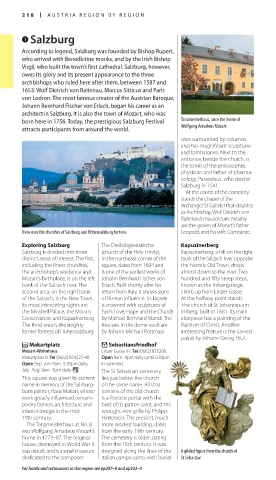
View over the churches of Salzburg and Hohensalzburg fortress Leo pold, and his wife Constanze.
Exploring Salzburg The Dreifaltigkeitskirche Kapuzinerberg
Salzburg is divided into three (church of the Holy Trinity), Kapuzinerberg, a hill on the right
distinct areas of interest. The first, in the northeast corner of the bank of the Salzach river opposite
including the finest churches, square, dates from 1694 and the historic Old Town, drops
the archbishop’s residence and is one of the earliest works of almost down to the river. Two
Mozart’s birthplace, is on the left Johann Bernhard Fischer von hundred and fifty steep steps,
bank of the Salzach river. The Erlach. Built shortly after his known as the Imbergstiege,
second area, on the right bank return from Italy, it shows signs climb up from Linzer Gasse.
of the Salzach, is the New Town. of Roman influence. Its façade At the halfway point stands
Its most interesting sights are is crowned with sculptures of the church of St Johannes am
the Mirabell Palace, the Mozart Faith, Love, Hope and the Church Imberg, built in 1681. Its main
Conservatoire and Kapuzinerberg. by Michael Bernhard Mandl. The altarpiece has a painting of the
The third area is the mighty frescoes in the dome vault are Baptism of Christ. Another
former fortress of Hohensalzburg. by Johann Michael Rottmayr. interesting feature is the carved
pulpit by Johann Georg Hitzl.
P Makartplatz R Sebastiansfriedhof
Mozart-Wohnhaus Linzer Gasse 41. Tel (0662) 875208.
Makartplatz 8. Tel (0662) 874227-40. Open 9am–4pm daily (until 6:30pm
Open Sep–Jun: 9am–5:30pm daily, in summer).
July–Aug: 9am–7pm daily. & The St Sebastian cemetery
This square was given its current lies just below the church
name in memory of the Salzburg- of the same name. All that
born painter, Hans Makart, whose remains of the old church
work greatly influenced contem- is a Rococo portal with the
porary fashion, architecture and bust of its patron saint, and the
interior design in the mid- wrought-iron grille by Philipp
19th century. Hinterseer. The present, much
The Tanzmeisterhaus at No. 8 more modest building, dates
was Wolfgang Amadeus Mozart’s from the early 19th century.
home in 1773–87. The original The cemetery is older, dating
house, destroyed in World War II, from the 15th century. It was
was rebuilt, and is a small museum designed along the lines of the A gilded figure from the church of
dedicated to the composer. Italian campo santo, with burial St Sebastian
For hotels and restaurants in this region see pp297–8 and pp322–3
218-219_EW_Austria.indd 218 03/09/15 5:30 pm
Eyewitness Travel LAYERS PRINTED:
Catalogue template “UK” LAYER
(Source v2.1)
Date 5th December 2012
Size 125mm x 217mm

