


Page 225 - (DK Eyewitness) Travel Guide 2016 - Austria
P. 225
SALZBURG 223
festival, and the stables were university as a temple of art Madonna from the earlier
con verted into the Small and and science. It features winged Gothic altar made by Michael
Grand Festival Theatres. One figures symbolizing music, Pacher, the outstanding artist of
of Austria’s most outstanding poetry, painting, architecture, the late-Gothic. The St Francis
architects, Clemens Holzmeister, theology, philosophy, law Chapel has frescoes by Johann
designed the Small Festival and medicine. Michael Rottmayr, with scenes
Theatre during the 1920s, and from the life of its patron saint.
then from 1956 until 1960 On the opposite side of
supervised the rebuild ing of the street are the monastery
the Grand Festival Theatre. buildings, which are connected
The building incorporates the with the church by a bridge.
original façade of the former
stables and is one of the largest P Residenz
opera houses in the world. Its Residenz: Residenzplatz 1. Tel (0662)
vast stage is 100-m (328-ft) wide 8042-2690. Open Sep–Jun: 10am–5pm
and is carved deep into the Wed–Mon; Jul & Aug: 10am–5pm
rockface of Mönchsberg. The daily. 8 = Residenzgalerie:
auditorium can easily accom- Tel (0662) 840451. Open same hours
modate up to 2,180 spec tators. as Residenz. & 8
The Residenz, seat of the
E Mozarts Geburtshaus Prince-Archbishop, the religious
Getreidegasse 9. Tel (0662) 844313. and secular ruler of the entire
Open Sep–Jun: 9am–5:30pm daily; province, was built for Archbishop
Jul & Aug: 8:30am–7pm daily. & 8 Wolf Dietrich von Raitenau. His
Hagenauerhaus, at No. 9 of successors further extended the
the narrow Getreidegasse, is building. Following seculari-
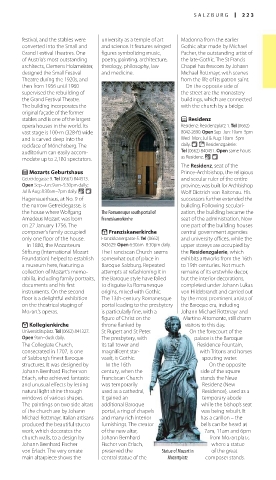
the house where Wolfgang The Romanesque south portal of zation, the building became the
Amadeus Mozart was born Franziskanerkirche seat of the administration. Now
on 27 January 1756. The one part of the building houses
composer’s family occupied R Franziskanerkirche central government agencies
only one floor of the house. Franziskanergasse 5. Tel (0662) and university offices, while the
In 1880, the Mozarteum- 843629. Open 6:30am–8:30pm daily. upper storeys are occupied by
Stiftung (International Mozart The Franciscan Church seems the Residenzgalerie, which
Foundation) helped to establish somewhat out of place in exhibits artworks from the 16th
a museum here, featuring a Baroque Salzburg. Repeated to 19th centuries. Not much
collection of Mozart’s memo- attempts at refashioning it in remains of its erstwhile decor,
rabilia, including family portraits, the Baroque style have failed but the interior decorations,
docu ments and his first to disguise its Romanesque completed under Johann Lukas
instruments. On the second origins, mixed with Gothic. von Hildebrandt and carried out
floor is a delightful exhibition The 13th-century Romanesque by the most prominent artists of
on the theatrical staging of portal leading to the presbytery the Baroque era, including
Mozart’s operas. is particularly fine, with a Johann Michael Rottmayr and
figure of Christ on the Martino Altomonte, still charm
R Kollegienkirche throne flanked by visitors to this day.
Universitätsplatz. Tel (0662) 841327. St Rupert and St Peter. On the forecourt of the
Open 9am–dusk daily. The presbytery, with palace is the Baroque
The Collegiate Church, its tall tower and Residence Fountain,
con secrated in 1707, is one magnificent star- with Tritons and horses
of Salzburg’s finest Baroque vault, is Gothic. spout ing water.
structures. It was designed by In the 16th On the opposite
Johann Bernhard Fischer von century, when the side of the square
Erlach, who achieved fantastic Franciscan Church stands the Neue
and unusual effects by letting was tempo rarily Residenz (New
natural light shine through used as a cathedral, Residence), used as a
windows of various shapes. it gained an temporary abode
The paintings on two side altars additional Baroque while the bishop’s seat
of the church are by Johann portal, a ring of chapels was being rebuilt. It
Michael Rottmayr. Italian artisans and many rich interior has a carillon – the
produced the beautiful stucco furnishings. The creator bells can be heard at
work, which decorates the of the new altar, 7am, 11am and 6pm
church walls, to a design by Johann Bernhard from Mozartplatz,
Johann Bernhard Fischer Fischer von Erlach, where a statue
von Erlach. The very ornate preserved the Statue of Mozart in of the great
main altarpiece shows the central statue of the Mozartplatz composer stands.
222-223_EW_Austria.indd 223 03/09/15 5:43 pm

