


Page 34 - (DK Eyewitness) Travel Guide 2016 - Austria
P. 34
32 INTRODUCING A USTRIA
Austrian Art Cathedral, and Jakob Seisen-
egger, a portrait-painter, were
Austrian painting, like the country’s literature, cannot be also influenced by Italian art.
considered in isolation from artistic movements in neigh
bouring countries. Art in Austria developed in close relationship Baroque
with German art, but it was also influenced by the Italian, In the 17th century, Italian
Hungarian and Czech cultures. Over many centuries, the art continued to influence
imperial court in Vienna acted as a strong magnet for artists Austrian painting. One of the
from all over Europe. In the 19th century, the artists of the most important painters of
Viennese Secession produced outstanding works of art. Some the Baroque period was
of Austria’s painters have gained international acclaim, but it is Pietro de Pomis.
The Austrian victory in the
well worth becoming acquainted with its lesser artists, too. Battle of Vienna in 1683 was a
historic event that proved very
From the 14th century, influential in the develop ment
panel painting flourished, of art. It brought about political
particularly in Vienna under and economic stability and with
Rudolph IV. The 15th century it many new artistic initiatives.
is notable for the works of The capital, Vienna, began to
Jakob Kaschauer and Thomas attract foreign artists, such as
von Villach. At the turn of Andrea Pozzo, the Italian master
the 16th century, Austrian of illusionist painting. Vast
paint ing was influenced by interior compositions were
Italian Quattrocento art, created to complement the
especially the works of magnificent architectural
Michael Pacher and his works by Johann Bernhard
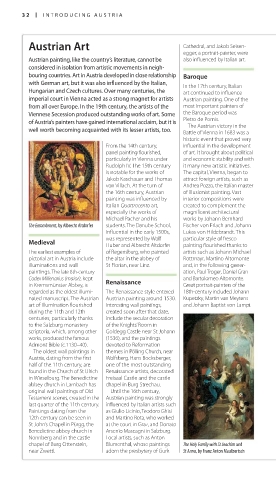
The Entombment, by Albrecht Altdorfer students. The Danube School, Fischer von Erlach and Johann
influential in the early 1500s, Lukas von Hildebrandt. This
was repre sented by Wolf particular style of fresco
Medieval
Huber and Albrecht Altdorfer painting flourished thanks to
The earliest examples of of Regensburg, who painted artists such as Johann Michael
pictorial art in Austria include the altar in the abbey of Rottmayr, Martino Altomonte
illumi nations and wall St Florian, near Linz. and, in the following gener-
paintings. The late 8th-century ation, Paul Troger, Daniel Gran
Codex Millenarius (maior), kept and Bartolomeo Altomonte.
in Kremsmünster Abbey, is Renaissance Great portrait-painters of the
regarded as the oldest illumi- The Renaissance style entered 18th-century included Johann
nated manu script. The Austrian Austrian painting around 1530. Kupetzky, Martin van Meytens
art of illumination flourished Interesting wall paintings, and Johann Baptist von Lampi.
during the 11th and 12th created soon after that date,
centuries, parti cu larly thanks include the secular decoration
to the Salzburg monas tery of the Knights’ Room in
scriptoria, which, among other Goldegg Castle near St Johann
works, produced the famous (1536), and the paint ings
Admont Bible (c.1130–40). devoted to Reformation
The oldest wall paintings in themes in Pölling Church, near
Austria, dating from the first Wolfsberg. Hans Bocksberger,
half of the 11th century, are one of the most outstanding
found in the Church of St Ulrich Renaissance artists, decorated
in Wieselburg. The Benedictine Freisaal Castle and the castle
abbey church in Lambach has chapel in Burg Strechau.
original wall paintings of Old Until the 16th century,
Testament scenes, created in the Austrian paint ing was strongly
last quarter of the 11th century. influenced by Italian artists such
Paintings dating from the as Giulio Licinio, Teodoro Ghisi
12th century can be seen in and Martino Rota, who worked
St John’s Chapel in Pürgg, the at the court in Graz, and Donato
Benedictine abbey church in Arsenio Mascagni in Salzburg.
Nonnberg and in the castle Local artists, such as Anton
chapel of Burg Ottenstein, Blumenthal, whose paintings The Holy Family with St Joachim and
near Zwettl. adorn the presbytery of Gurk St Anna, by Franz Anton Maulbertsch
032-033_EW_Austria.indd 32 03/09/15 5:40 pm

