


Page 29 - (DK Eyewitness) Travel Guide 2016 - Austria
P. 29
A POR TR AIT OF A USTRIA 27
Austrian Fauna
Austrian fauna is typical of Central Europe.
Along with invertebrates (primarily insects:
beetles and butterflies), it features a rich
avifauna, small numbers of amphibians (newts,
salamanders, fire-bellied toads and frogs) and
reptiles (Aesculapian snake, grass snake, lizards),
and mammals, including rodents, marten, fox,
weasel and hoofed animals. Mountain animals –
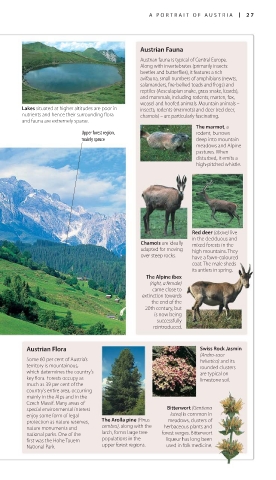
Lakes situated at higher altitudes are poor in insects, rodents (marmots) and deer (red deer,
nutrients and hence their surrounding flora chamois) – are particularly fascinating.
and fauna are extremely sparse.
The marmot, a
Upper forest region, rodent, burrows
mainly spruce deep into mountain
meadows and Alpine
pastures. When
disturbed, it emits a
high-pitched whistle.
Red deer (above) live
in the deciduous and
Chamois are ideally mixed forests in the
adapted for moving high mountains. They
over steep rocks. have a fawn-coloured
coat. The male sheds
its antlers in spring.
The Alpine ibex
(right, a female)
came close to
extinction towards
the end of the
20th century, but
is now being
successfully
reintroduced.
Austrian Flora Swiss Rock Jasmin
(Andro-sace
Some 60 per cent of Austria’s helvetica) and its
territory is mountainous, rounded clusters
which determines the country’s are typical on
key flora. Forests occupy as limestone soil.
much as 39 per cent of the
country’s entire area, occurring
mainly in the Alps and in the
Czech Massif. Many areas of
special environmental interest Bitterwort (Gentiana
enjoy some form of legal lutea) is common in
protection as nature reserves, The Arolla pine (Pinus meadows, clusters of
nature monuments and cembra), along with the herbaceous plants and
national parks. One of the larch, forms large tree forest verges. Bitterwort
first was the Hohe Tauern populations in the liqueur has long been
National Park. upper forest regions. used in folk medicine.
026-027_EW_Austria.indd 27 03/09/15 5:40 pm

