


Page 43 - (DK Eyewitness) Travel Guide 2016 - Austria
P. 43
THE HIST OR Y OF A USTRIA 41
THE HISTORY
OF AUSTRIA
During the Middle Ages, Austria was only one of several small duchies within the
Holy Roman Empire, but during 600 years of Habsburg rule it rose to the ranks of a
world power and was a determining factor in Europe’s fate. The Austro-Hungarian
Empire ended with World War I. Since the end of World War II, Austria has been a
central element in European democracy.
Prehistory and Early Middle Ages consolidated during the 7th and 8th
The geographic nature of Austria’s territory, centuries, was crushed in 787 when
opening up towards the Bohemian- Charlemagne deposed his vassal Tassilo
Moravian Valley and the Hungarian Plains, III, the last Prince of Bavaria, and annexed
meant that, from the 7th century BC, this his territories. In 803, Charlemagne also
area was regularly raided and populated by defeated the Avars and established a
belli gerent Scythians, Celts and Germanic margravate (territory) on the banks of the
tribes. At the end of the 1st century BC, Danube, between the Enns River and
the land south of the Danube was the Vienna Woods, which became the
occupied by the Romans, who in the nucleus of the Austrian state. Its existence
middle of the 1st century AD, during the was cut short by Magyars, who raided it
reign of the Emperor Claudius, founded in the early 10th century.
the Province of Noricum here, with its
main centres in Carnuntum (near Hainburg) Babenberg Austria
and Vindobona (Vienna). Following the defeat of the Magyars in
The influence of the dominant Roman 995, on the banks of the Lech River near
culture and civilization over the entire Augsburg, the German King Otto I restored
region began to wane in the 2nd century the margravate; his successor, Otto II,
AD, during a period of increased German handed it as a fief to Leopold I of the
raids. In AD 180, Emperor Marcus Aurelius Babenberg dynasty (976–94). The centre
died in Vindobona, in the war against the of the margravate was Melk, on the
Marcomanni and Quadi tribes. Danube river. Having defeated the Magyars,
From the 4th century onwards, during the Leopold extended the frontiers of his
Great Migration of Nations, the territories of province up to the Vienna Woods. In 1156,
present-day Austria saw successive waves Henry II Jasomirgott was given the title of
of invading Huns, Goths and Avars. Later Duke, and Austria became a hereditary fief
arrivals included Slav and Bavarian settlers. of the Empire. Vienna began to assume
The Bavarian tribal state, established and its role as capital city.
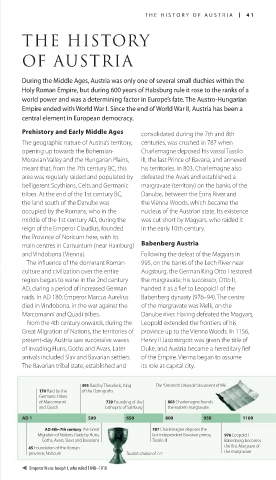
493 Raid by Theodoric, King The “Ostarrichi Urkunde” document of 996
170 Raid by the of the Ostrogoths
Germanic tribes
of Marcomanni 739 Founding of the 803 Charlemagne founds
and Quadi bishopric of Salzburg the eastern margravate
AD 1 500 650 800 950 1100
AD 4th–7th century The Great 787 Charlemagne deposes the
Migration of Nations. Raids by Huns, last independent Bavarian prince, 976 Leopold I
Goths, Avars, Slavs and Bavarians Tassilo III Babenberg becomes
45 Foundation of the Roman the first Margrave of
province, Noricum Tassilo’s chalice of 777 the margravate
Emperor Franz Joseph I, who ruled 1848–1916
040-043_EW_Austria.indd 41 03/09/15 5:40 pm

