


Page 47 - (DK Eyewitness) Travel Guide 2016 - Austria
P. 47
THE HIST OR Y OF A USTRIA 45
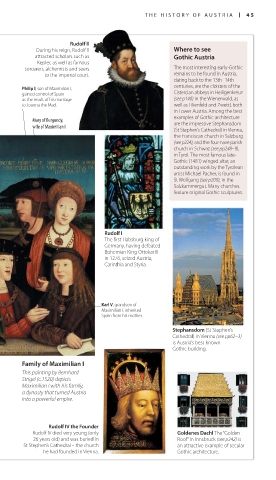
Rudolf II
During his reign, Rudolf II Where to see
attracted scholars such as Gothic Austria
Kepler, as well as famous
sorcerers, alchemists and seers The most interesting early-Gothic
to the imperial court. remains to be found in Austria,
dating back to the 13th–14th
centuries, are the cloisters of the
Philip I, son of Maximilian I,
gained control of Spain Cistercian abbeys in Heiligenkreuz
as the result of his marriage (see p140) in the Wienerwald, as
to Joanna the Mad. well as Lilienfeld and Zwettl, both
in Lower Austria. Among the best
examples of Gothic architecture
Mary of Burgundy,
wife of Maximilian I are the impressive Stephansdom
(St Stephen’s Cathedral) in Vienna,
the Franciscan church in Salzburg
(see p224), and the four-nave parish
church in Schwaz (see pp248–9),
in Tyrol. The most famous late-
Gothic (1481) winged altar, an
outstanding work by the Tyrolean
artist Michael Pacher, is found in
St Wolfgang (see p209), in the
Salzkammergut. Many churches
feature original Gothic sculptures.
Rudolf I
The first Habsburg king of
Germany, having defeated
Bohemian King Ottokar II
in 1276, seized Austria,
Carinthia and Styria.
Karl V, grandson of
Maximilian I, inherited
Spain from his mother.
Stephansdom (St Stephen’s
Cathedral) in Vienna (see pp62–3)
is Austria’s best-known
Gothic building.
Family of Maximilian I
This painting by Bernhard
Strigel (c.1520) depicts
Maximilian I with his family,
a dynasty that turned Austria
into a powerful empire.
Rudolf IV the Founder
Rudolf IV died very young (only Goldenes Dachl The “Golden
26 years old) and was buried in Roof” in Innsbruck (see p242) is
St Stephen’s Cathedral – the church an attractive example of secular
he had founded in Vienna. Gothic architecture.
044-045_EW_Austria.indd 45 03/09/15 5:40 pm

